Introduction When purchasing or forwarding a fall/winter Argentina jersey, packaging choices can affect package dimensions, volumetric weight, billable weight, and available routes. Judging solely by "removing original packaging saves more" or "reinforcement is always safer" can lead to choosing the wrong option before warehouse measurements. This article focuses on a pending Argentina jersey, providing methods to verify three packaging options. Curre
Introduction
When purchasing or forwarding a fall/winter Argentina jersey, packaging choices can affect package dimensions, volumetric weight, billable weight, and available routes. Judging solely by "removing original packaging saves more" or "reinforcement is always safer" can lead to choosing the wrong option before warehouse measurements.
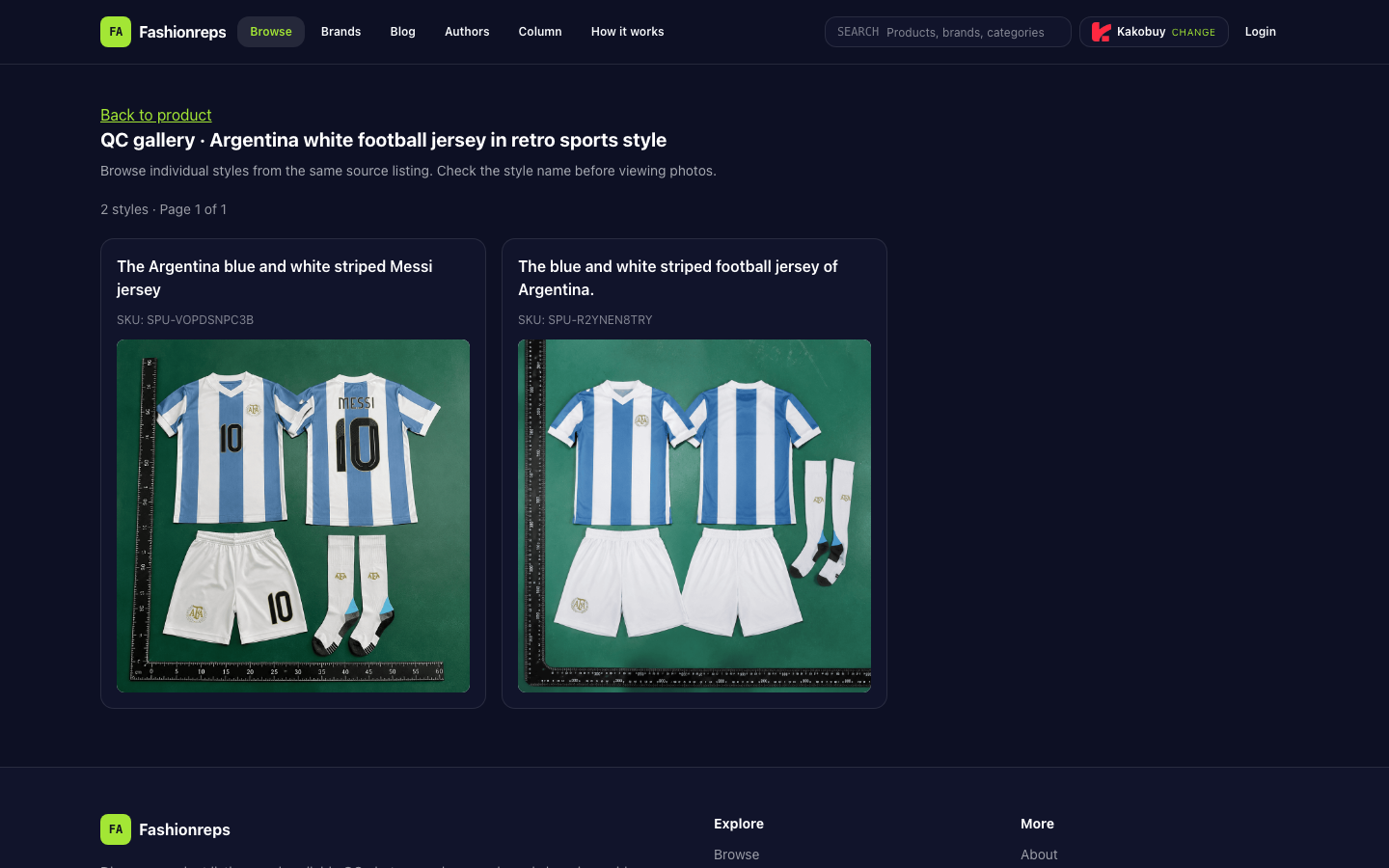
This article focuses on a pending Argentina jersey, providing methods to verify three packaging options. Currently confirmed from the product page are two styles: Argentina blue-and-white striped Messi jersey, SKU SPU-VOPDSNPC3B; and blue-and-white striped soccer jersey, SKU SPU-R2YNEN8TRY. The product page does not provide the post-packaging dimensions, actual weight, volumetric weight, billable weight, packaging fees, taxes, or route eligibility data needed for this article, so no option is presumed cheaper, and no unverified amounts are output.

First Confirm the Specific Item to Ship
Before ordering or submitting a warehouse packing request, record the style name, size, color, and SKU from the product page. The page currently shows two blue-and-white related styles, so you cannot judge the actual item merely by the abbreviation "Argentina jersey."
It is recommended to keep the following information:
- Product page name and screenshot
- Specific style or item name
- Size and color
- SKU
- QC images or warehouse identification after arrival
- Destination country or region
- Intended agent and route name
If upon arrival the style, size, or color does not match your records, pause packaging option comparison to avoid incorporating the wrong item's weight and dimensions into shipping cost decisions.
What to Verify for Each of the Three Packaging Options
Option 1: Keep Original Packaging
Keeping original packaging is suitable when prioritizing product protection, appearance integrity, or future gifting. However, it may increase external dimensions and possibly make volumetric weight higher than the garment's actual weight.
When asking the agent, request the following:
- Length, width, and height with original packaging
- Actual weight after removing external shipping materials
- Volumetric weight calculation method and billable volumetric weight
- Whether final billable weight uses actual or volumetric weight
- Whether the target route accepts that size and weight
- Any additional packaging fees or size restrictions
Do not simply assume how much extra shipping cost keeping original packaging adds because the garment itself is light. Packaging shape, route formulas, and destination all affect the outcome.
Option 2: Remove Non-Essential Packaging
Removing non-essential packaging usually aims to reduce outer materials and space, but effectiveness must be based on warehouse re-measured data. If the original packaging does not occupy significant volume, removal may not yield enough billable weight change; if the route has a minimum billable weight, it may not result in actual savings.
When requesting this option, clearly ask the agent to specify:
- Which layer of packaging is removed
- Whether folding and moisture protection of the jersey will be affected
- Dimensions and actual weight after repacking
- Recalculated volumetric weight and billable weight
- Whether original packaging can be saved or returned separately
- Handling fees, return restrictions, and damage liability
"Remove box" or "remove packaging" is not a precise operational description. Buyers should have the warehouse confirm the exact items removed before comparing before/after data.
Option 3: Reinforced Protection
Reinforced protection suits scenarios with longer transit times, multiple transfers, or when buyers prioritize crush and moisture resistance. Reinforcement materials may add weight and expand external dimensions, so you cannot compare only material costs.
Also require the agent to provide:
- Type and scope of reinforcement materials
- Package dimensions after reinforcement
- Actual weight after reinforcement
- Volumetric weight and billable weight
- Whether the target route allows this packaging method
- Reinforcement service fees and any additional restrictions
If volumetric weight increases after reinforcement but the route still bills at the higher billable weight, buyers need to weigh the added protection value against extra costs, not just the packaging service fee.
Checklist That Can Be Established Now
| Verification Item | Current Status | Requirement Before Shipping |
|---|---|---|
| Item style and SKU | Page confirms two blue-and-white striped related styles | Confirm actual style with warehouse QC info |
| Post-packaging dimensions | Not provided | Measure length, width, height for each of the three options |
| Actual weight | Not provided | Weigh by warehouse and record units |
| Volumetric weight | Not provided | Calculate per target agent and route formula |
| Billable weight | Not provided | Confirm rule for actual vs volumetric weight |
| Route eligibility | Not provided | Confirm after entering destination, dimensions, weight |
| Packaging fees and taxes | Not provided | Use settlement page or official calculator results |
| Return restrictions | Not provided | Confirm non-shippable or return conditions before shipping |
This table distinguishes "known product information" from "information that must be measured after packaging" and does not indicate any option is already eligible for shipping.
How to Request Comparable Quotes from 2–3 Agents
To make results comparable, provide each agent with the same information: item style, size, destination, whether to consolidate, three packaging requirements, and the route range you wish to query. Do not just ask "which is cheapest"; require complete fields in return.
Follow this order:
- Confirm the item has arrived at the warehouse and obtain QC images or warehouse identification.
- Ask the agent to provide estimated or measured data for keeping original packaging, removing non-essential packaging, and reinforced protection.
- Require each option to list dimensions, actual weight, volumetric weight, billable weight, packaging fees, taxes, and route eligibility.
- Record query time, currency, destination, and route name.
- Mark options without measured data as "pending measurement" and do not treat as final quotes.
- Compare using data from the same destination, billing rules, and similar query times.
If an agent only gives a total price without dimensions, billable weight, or route conditions, treat the result as incomplete and cannot be used to prove one packaging option is more cost-effective.
When to Pause Shipping
Consider pausing payment or shipping submission if any of the following occur:
- Warehouse has not provided post-packaging dimensions and weight
- The three options use different destinations or routes, preventing comparison
- Route eligibility is not confirmed
- Billable weight rule is unclear
- Packaging fees, taxes, or surcharges lack currency and applicable conditions
- Item style or SKU does not match order records
- After removing packaging, moisture, crush protection, or return liability is unclear
- Quotes are outdated, or route pages changed without re-querying
This step is important because "looks lighter" does not mean "can be shipped" or "ultimately cheaper."
Final Selection Logic
If the buyer prioritizes appearance integrity, verify the keep-original-packaging option's dimensions and route restrictions first. If the main goal is reducing space, have the warehouse re-measure after removing non-essential packaging. If destination transport risk is high, evaluate reinforced volumetric weight, billable weight, and additional fees together.
Based on current evidence, it cannot be determined which option definitely saves shipping costs, nor can any specific route be confirmed to accept this jersey. The prudent approach is to first confirm the actual style, then have 2–3 agents complete measurements for the three options using the same destination and fields. Only when dimensions, billable weight, route eligibility, and related fees are clear should you make the final shipping decision.
Data verification date: November 1, 2026. Current records support only item style and SKU information; packaging, shipping, and fee data still require warehouse measurements, agent official calculators, or settlement pages.
Editor score 4.2 / 5