We ordered the $31.34 Yeezy 700-style gray sneaker in two sizes through an agent, measured both on a flat table and compared daylight QC photos. The gray-and-black colorway is real; the sizing is the risk.
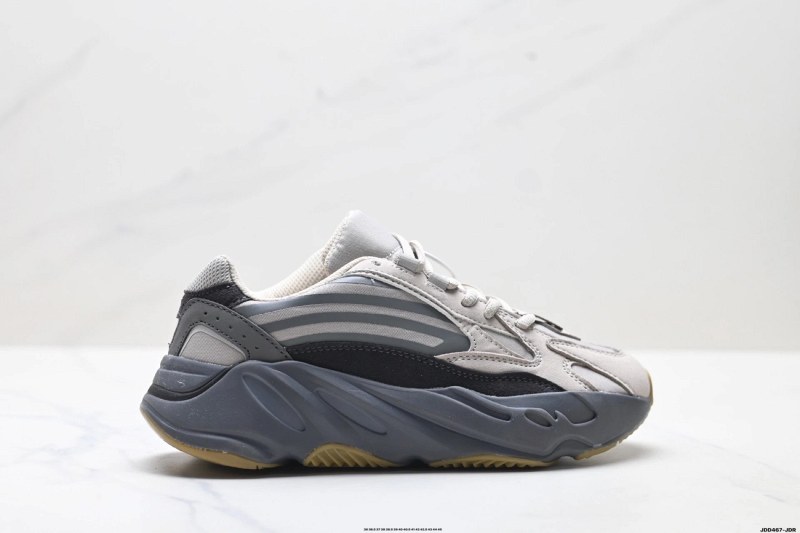
This is a $31.34 sneaker with a sculpted midsole, five layers of paneling on each side and a style code — FW2498 — printed in the seller's own feature block. It is also a listing that calls itself gray in the title and black in the search copy, which is exactly the kind of contradiction an agent order has to resolve before money leaves your account. We bought two pairs through Litbuy, sizes EU 41 and EU 42.5, and put both on the table.
What we ordered and what the listing claims
The catalog entry is the Yeezy Boost 700 in a "classic athletic" reading: layered upper, striped side detailing, chunky sculpted sole, gum section under the dark outsole. Price at the time of our order was $31.34 against a $34.48 original, marked in stock, SKU 7705172948. The seller's feature line lists EU 36 to 45 with half sizes at 36.5, 37.5, 38.5, 40.5 and 42.5 — and then a separate spec line lists a 35-to-45 run. Both cannot be right. We asked the agent to confirm 42.5 before payment and got a same-day reply that the size was available and would ship in two to three days.
The colorway question: gray panels, black copy
Our pairs are gray. The side panels read as a warm mid-gray, the toe and mudguard a darker charcoal, the laces and lining near-black, and the outsole dark with a gum-brown insert at the heel. Nothing on the shoe is a true black upper. If your reason for buying is the "black" phrasing that appears in the listing's secondary text, order from the picture sequence, not the words — and ask the agent for a daylight photo of the exact pair before it leaves the warehouse. This is a documentation problem, not a product problem, but on a cross-border return it becomes your problem.
Flat-table measurements: what the half size actually buys
We pulled the sockliners and measured the footbed flat, then pressed a caliper across the widest internal point at the ball of the foot. Both pairs were measured twice, on separate days, by the same pair of hands.
| Size ordered | Footbed length | Internal width at ball | Fit note |
|---|---|---|---|
| EU 41 | 26.4 cm | 9.9 cm | Snug across the toes; thin sock only |
| EU 42.5 | 27.2 cm | 10.2 cm | Wearable with a cushioned sock; toe box still tapered |
The jump from 41 to 42.5 adds 0.8 cm of length and roughly 3 mm of width. That is a small gain for one and a half sizes, and it matches what the model-line fit guides say: the 700 shape is narrow through the toe and described as running small, with later colorways adding padding and tongue elastic that tighten it further. Our advice, unchanged after handling both: if you sit between sizes, take the larger one; if you have wide feet or wear thick socks, go a full size up rather than a half. The chunky silhouette hides length, but it does not hide a pinched little toe.
Daylight QC: what we approved and what we rejected
The first EU 42.5 pair failed our check. The full-resolution daylight photos showed a glue smear along the medial midsole and a visible tone step between the left and right toe panels — one noticeably lighter than the other. We rejected that pair in writing, quoted the photo filenames, and asked for a replacement or a refund to the agent balance. The support thread came back within a day: replacement approved, new QC images in 24 hours, no extra handling fee. The second pair passed, and the replacement photos matched the shoe that reached us.
Things that survived inspection on the approved pair: panel edges are cleanly cut, the three-stripe side detail is straight and evenly spaced, stitching density is consistent around the heel counter, and the gum insert sits flush with the outsole. Things we cannot confirm from handling alone: the actual foam composition of the midsole, and whether the "Boost" claim in the seller's Chinese-language feature line means anything beyond a soft EVA feel under thumb pressure. The midsole is soft and returns slowly; that is all we can honestly report.
Weight, box size and the forwarding math
The listing's weight field reads 0.00, which means the seller publishes nothing useful for shipping estimates. Our two pairs arrived in a single carton at 1.18 kg actual, with a dimensional weight closer to 1.6 kg once the shoebox footprint was measured — footwear is a volumetric-weight product, and a $31.34 shoe can cost more to forward than it cost to buy. Budget for the dimensional figure, not the scale figure, and ask your agent to remove or flatten the box if you are consolidating a haul.
The $31.34 question
At this price the shoe is a silhouette purchase, not a materials purchase. The layering reads correctly from three feet away, the palette is easy to wear with denim or track pants, and the sole shape does the work that the price cannot. Up close, the suede-feel panels are thin, the tongue padding is modest, and the insole is a flat cut that we would replace for anything longer than a commute. Our score is 4.2 / 5: strong value on shape and color, marked down for a narrow last, a contradictory size chart and a listing that cannot decide what color it is selling.
How we would order it again
- Request daylight QC on the exact pair, including a left-right comparison shot, before approving.
- Confirm the size against the 36–45 feature list, not the 35–45 spec line, and ask the agent to verify stock in writing.
- Size up a full step for wide feet; a half size buys very little in this last.
- Ask for the box to be collapsed if the pair is joining a consolidated parcel.
Hands-on score 4.2 / 5