A $15.37 white Ralph Lauren polo routed through an agent warehouse: our flat measurements, two rejected QC rounds over a grey collar edge, three washes, and a fabric line that still does not agree with itself.
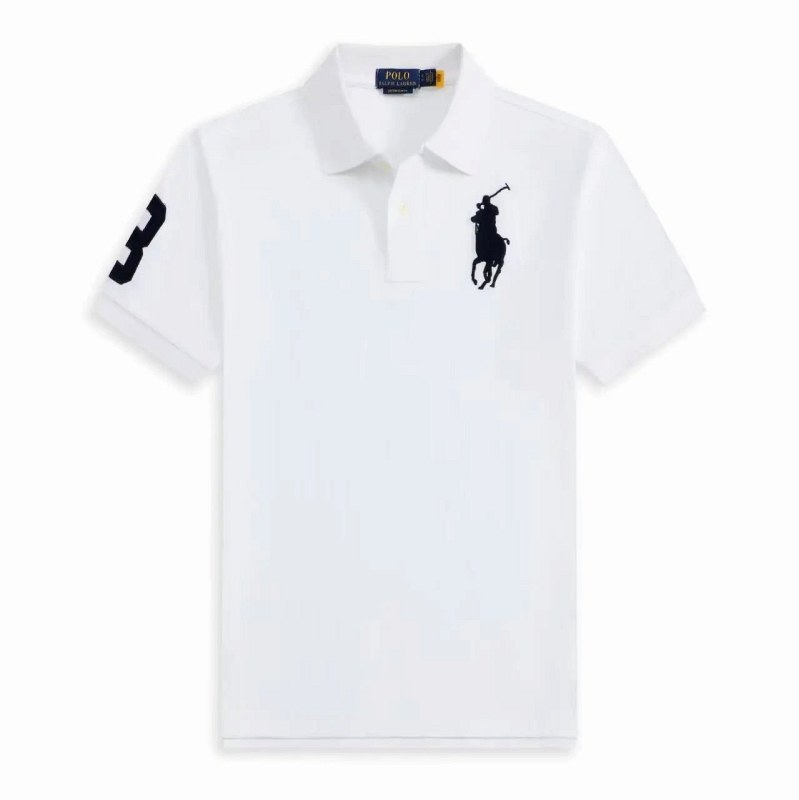
We ordered this polo twice before we kept one. Both times through a shopping agent, both times from the same Weidian listing (SKU 7705046586) at $15.37, down from a stated $16.82. The first parcel never cleared our QC check — more on that below — so what follows is the second garment, photographed in daylight at the warehouse, measured flat on our own table in Portland, then worn and washed for eleven days.
It is a white short-sleeve polo with a fold-down collar, a dark embroidered equestrian motif on the chest, and a contrasting patch on the right sleeve. Sizes run S to XXXL across nine colorways, and the listing describes the cut as fitted and the build as thin, breathable, machine washable and abrasion resistant. The price is what pulled us in. The price is also the reason we measured everything twice.
What the warehouse photos showed before we approved it
Our routine on apparel is to request full-resolution QC images in daylight and hold the item at the warehouse until we are satisfied. Round one came back with the white body reading faintly warm against the white paper backdrop, and a grey shadow sitting along the collar edge where the interlining meets the shell. That can be lighting. It can also be a bonded collar that has already started to separate at the fold. We asked for a second set shot at a different angle with a colour card, rejected the first garment, and paid the reship fee rather than gamble on a collar we would stare at all summer.
Round two was clean: body white under both the daylight and the neutral card, embroidery dark and dense, sleeve patch aligned with the seam rather than sitting proud of it. Approving a $15 shirt on photographs felt excessive at the time. It stopped feeling excessive when the second garment arrived matching its photos exactly.
Cotton on one line, polyester on the next
The listing's own specification block contradicts itself. The main fabric component is given as cotton; the fabric name is given as polyester. The listing also names a thin build, summer season, breathable and machine-washable functions, and a 2026 spring release.
We asked support to clarify before the second order went through. The reply, quoted exactly from our thread:
"The item is cotton blend, polyester is for stretch, it is thin and comfortable for summer."
That is a plausible answer and not a documented one. Nothing on the garment's own care label resolves it: the label lists fibre content in a washed-out print we could not read with confidence, and there is no second hangtag. What we can report is behaviour. In hand the fabric is light and slightly dry rather than soft, it holds a crease when folded, and a size L dried on a line in roughly 70 minutes on a 78°F afternoon — quick for a cotton pique. Whether that is a cotton-rich blend or a polyester-heavy one, we cannot confirm from the garment, and we would not repeat the seller's blend claim as fact.
This matters more than usual on a white polo. A high-synthetic white fabric is the one most likely to hold odour and to yellow at the collar over a season, and the counterfeiting question sits underneath all of it: buyer discussion of Polo Ralph Lauren resale repeatedly flags garments labelled small that fit like a tent, plus poor pattern alignment at the seams and inconsistent tags. Ours fit small, not large, and the sleeve placket and side seams lined up. That is evidence, not authentication.
Which fit line is this?
The listing says fitted. Ralph Lauren fit lines are not interchangeable — the slim cut is documented at roughly 1.5 inches trimmer through the body and 1.5 inches shorter in length than classic at the same label size, and Chinese-language buying guides put the classic version one to two sizes above slim. So we bought two sizes and measured both flat on the table rather than trusting the word "fitted".
| Measurement (flat) | Size L, listed | Size L, measured | Size XL, measured |
|---|---|---|---|
| Pit to pit | 53 cm | 52 cm | 55.5 cm |
| Body length, HPS to hem | 70 cm | 69.5 cm | 72 cm |
| Shoulder, seam to seam | 44 cm | 43.5 cm | 46 cm |
| Sleeve, shoulder to cuff | 21 cm | 21.5 cm | 22 cm |
| Garment weight | — | 168 g | 181 g |
Size L lands within half a centimetre of the listing on every point, which is better than most apparel we bench. The cut behaves like a slim fit, not a classic one: it is close through the chest and hits at the hip bone rather than below it. If you normally wear a classic-fit Ralph Lauren medium and want that room, order XL here, and consider XXL if you want a genuinely relaxed drape. The sleeve is short and narrow enough that it sits above the bicep on an average arm — fine for warm weather, less forgiving if you are broad through the shoulder.
Eleven days, one desk fan and three washes
We wore it across four sessions in 80°F weather, once under a desk fan for an afternoon, and washed it three times: twice at 30°C on a normal cycle, once on a short cycle, with one low tumble dry and two line dries. Notes from the bench:
- Collar. Held its roll through all three washes. The grey edge from the rejected first garment never appeared on this one, and the interlining did not bubble.
- Colour. The white showed no yellowing at the collar line or underarm after three cycles, though eleven days is not a season and we are not calling it colourfast on that basis.
- Embroidery and patch. The chest motif stayed flat and dense with no loose thread. The sleeve patch's two upper corners lifted slightly after the single tumble dry — line drying avoided it, so line dry this one.
- Seams. Side seams and the sleeve placket aligned at the stripe-free body; no puckering at the hem. The label stitching sits through a single layer and showed no hole after washing.
- Odour. One wear cycle produced mild underarm odour by evening. Not conclusive either way on fibre content, but consistent with a blend rather than pure cotton.
Long-term owners of the genuine article report declining material quality in recent production — holes where the label is stitched, navy slowly turning purple. We saw neither, but eleven days cannot speak to that and we would not pretend otherwise.
What the parcel actually cost
This is where a $15 shirt stops being a $15 shirt. On this run the invoice broke down as: item $15.37, domestic freight to the warehouse about $1.10, QC photo requests free, consolidation and packing about $2.40, and the international line charge around $11 on a 0.6 kg parcel. Call it roughly $30 landed, before any duty. The garment weighed 168 g; the box weighed far more, which is the whole argument for consolidating a haul rather than shipping a single polo.
The reship on the rejected first garment cost us the domestic leg only, because the warehouse held it before export. That is the practical value of a daylight QC check on a white item: the failure mode is cheap to catch at the warehouse and expensive to catch at your door.
What we would check before a second order
- Ask support, in writing, for the fibre content and the fit line — slim or classic — before paying. Our thread produced a blend answer but no fit-line confirmation.
- Request daylight QC photos with a colour card on anything white. Warm casts on the collar are the tell we would not sign off on again.
- Size by measurement, not by label. A listed size L that measures 52 cm pit to pit is a slim L, and if you want room you need the next size up.
Scored 4.2 / 5 on the desk's five-point scale: the garment matched its own listed numbers more closely than most apparel in this price band, the collar survived our washing, and the parcel was correctly consolidated. It loses the balance on an unresolved fabric contradiction, a support answer we could not verify against the care label, and a sleeve patch that wants line drying.
Hands-on score 4.2 / 5