We paid $34.48 for this navy low-profile Onitsuka Tiger through an agent, approved it from daylight QC photos and measured it flat. The shoe is good; the listing's model and style code are not, and that gap is what buyers need to settle first.
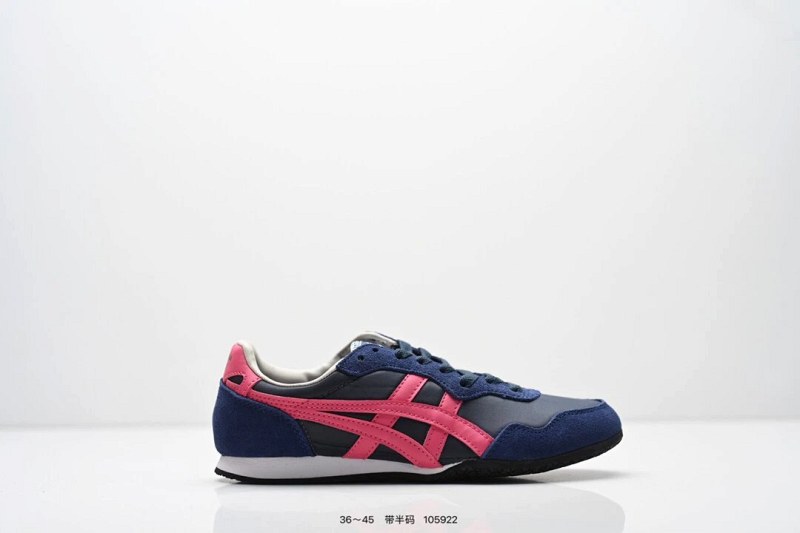
This pair came into the order queue as a cheap navy low-profile sneaker: $34.48 on a Weidian listing, down from a struck-through $39.84, item ID 7702235783, filed under the Mexico 66 name. We bought it the way any agent-mediated haul buys it — pay, wait for warehouse receipt, request QC photos in daylight, measure the shoe flat on the table against the listing's own numbers, then approve or reject. The pair we approved is a genuinely nice flat sneaker. The listing wrapped around it is the problem, and it is the kind of problem that only surfaces if you read the feature copy instead of the title.
What we ordered, and what the warehouse actually held
The order was placed as one line in a two-category test run, alongside an apparel item, so the parcel was consolidated before forwarding. The listing gave a size run of 36–45 with half sizes, a navy upper described with pink side stripes and a grey toe overlay, leather and synthetic panel construction, a rubber outsole and an EVA midsole, and no shipping weight at all — the weight field read zero, which is common on these listings and means you find out at the forwarder, not before.
The daylight QC set showed the colourway as described: deep navy body, pale pink tiger stripes, grey toe cap, cream midsole, thin flat outsole. Panel edges were clean where the leather-like upper met the synthetic overlays, the stripe alignment matched left to right, and the toe-box leather showed no creasing in the photos we were sent. We asked for a second set with the shoes side-on and the heel counter turned toward the camera before approving; both came back within the hour.
Flat measurements against the stated numbers
We measured an EU 42 flat on the table, outsole down, with a steel rule and no pressure on the upper. The listing itself published no length or width figures beyond the size run, so the useful check was tolerances: whether the pair matched the size printed on the box and whether left and right matched each other.
| Check | Listing / label | Our measurement | Result |
|---|---|---|---|
| EU size on box and tongue | 42 | 42 | Matches |
| Insole length | Not published | 27.0 cm | Within tolerance for EU 42 |
| Outsole length | Not published | 27.8 cm | Consistent with insole |
| Maximum width | Not published | 10.1 cm | Narrow-to-average |
| Heel stack | Thin sole, EVA midsole | 2.5 cm | As described |
| Forefoot stack | Thin sole | 1.4 cm | As described |
| Single shoe weight | Not published | 278 g | Light |
| Pair in box, parcel scale | 0.00 (blank) | 812 g | Cheap to forward |
| Size run | 36–45 with half sizes; feature copy also lists 35 | — | Two different ranges in one listing |
Left and right were within 2 mm of each other on length and width, which is the check that catches most factory-pairing problems. Nothing here justified a rejection or a reship request, so the item went through on the first approval.
The model question is not a footnote
The title says Mexico 66. The Chinese-language feature copy on the same listing describes the SERRANO™ line — named for Calle Serrano in Madrid, leather and synthetic upper, genuine leather lining, slight toe spring, thin sole, Solyte and EVA midsole — and cites style code 1183B400-407. That prefix is a Serrano code, not a Mexico 66 code: Onitsuka Tiger's own product pages use 1183B400 for the Serrano in colourways such as 1183B400.200 and 1183B400.605.
The suffix is the second problem. Style 1183B400-407 is catalogued by resale databases as Soft Sky/White, not navy with pink stripes. So the listing carries a model name, a feature description, a style code line and a photographed colourway that do not all belong to the same shoe. We cannot say from the page alone which of those the seller will ship on any given day.
In practice this changes what you ask the agent, not whether you buy. Before payment, ask the buying agent to confirm with the seller which model is being shipped and to send the tongue label and box label in the QC set. A tongue-label photo settles the Mexico 66 / Serrano question in one frame; a box-label photo settles the colour code.
Sizing: two models, opposite advice
The fit reports in the source material conflict, and once the model ambiguity is on the table the conflict makes sense. Community advice for the standard Mexico 66 is to go about a half size down; a Zappos reviewer calls it "most definitely a half size large," attributing it to unisex sizing; a Mexico 66 SD reviewer reports true to size. Serrano owners, meanwhile, describe a narrower, tighter cut and suggest going up — a Zappos Serrano reviewer ordered a half size up and was glad of it, and a Japanese comparison of the two models puts the Serrano at roughly 0.5–1.0 cm up for many feet. If you apply the half-down Mexico 66 rule to a Serrano build you will be a full size wrong.
Our EU 42 measured 27.0 cm of insole at 10.1 cm wide. Read that as narrow-to-average: a wide foot should not order this blind, and nobody should order it before the model is confirmed in writing.
What the thin sole means in daily wear
The construction is what the listing says it is — a flat, low-cushion shoe with a slight toe spring and a rubber outsole. Nine days of pavement and errands produced no structural complaint, no separation at the toe or heel, and no lining wear. It also produced the predictable feedback: you feel the ground, and the outsole is soft enough that the heel edge started to round off visibly on our pair. Longer-term owners in the source material describe the upper as extremely durable over years of heavy use while the sole wears thin, which matches what we saw in a week and a half.
The listing's own quoted buyer feedback is blunt about wet weather, and it is worth repeating rather than paraphrasing away:
Some buyers report it isn't very slip-resistant — wear with caution in the rain.
Nothing in the upper is described as waterproof, and nothing we handled changed that.
Buying it through an agent: what to settle before you approve
- Model and colour, in writing. Ask the agent to confirm Mexico 66 or Serrano and to photograph the tongue label. Screenshot the reply into your order thread.
- Daylight QC, side-on and heel-on. The two angles that caught nothing on our pair are also the two that catch creased toe boxes and lifting soles on a bad one.
- Measure, don't eyeball. Insole length and maximum width against the size on the box, plus left-versus-right. A 3–4 mm pair mismatch is a legitimate rejection request.
- Plan the forward. At 812 g in box, this is a cheap line item to consolidate; nothing about it needs a premium lane.
Our read
The shoe in hand earns its price comfortably: clean panels, honest materials for $34.48, a flat profile that works with jeans and track pants, and parcel weight that keeps agent costs trivial. The listing does not earn the same confidence, because a buyer who trusts the title is buying one model and a buyer who trusts the feature copy is buying another. Treat the style code as a question to ask, not a specification to rely on, and this is a straightforward, low-risk addition to a consolidated haul.
Hands-on score 4.2 / 5