A $3.88 Nike logo tee routed through an agent warehouse makes a clean first test: light, flat-packed, easy to judge on print alignment in QC photos, and a clear baseline for warehouse-to-door timing. Score: 4.2 / 5.
By Priya Raghavan, Reviews Editor · Tested September 2026
Why a $3.88 printed tee is the right first item to route through an agent
We ordered and tested the Nike Classic Logo Printed T-Shirt, SKU 7715836021, as the control item in a Litbuy-agent test run that also carried a second category. The source listing shows a reference price of $3.88 USD against a struck-through $4.49, and it is marked in stock. Final item price, agent service fees and international shipping are confirmed on the shopping agent's site, not on the listing. At that price the tee's job in a first order is not to impress anyone — it is to be measurable.
Three properties make it a clean control item. It is light, it is flat, and its quality is visible from the outside. A printed short-sleeve tee has no hardware, no fill, no structured panels and no hidden interior, so a set of warehouse QC photos can answer almost every question you would want answered before you approve it. Compare that with a padded jacket, where loft, fill distribution and packed volume each need a separate judgement — an expensive first order to learn on.
What the listing states, and how we verified it
The listing is specific in most places and contradictory in one. This is the table the desk works from at the QC stage:
| Specification | What the listing states | How we check it |
| Sizes | L, XL, 2XL, 3XL, 4XL and 5XL, with a stated 1–3 cm measurement tolerance | Flat measurement of chest, body length, shoulder and sleeve against the listed numbers for the size ordered |
| Fit | Loose cut, Korean style, standard thickness | A roomy cut shows up as a wide chest at a given body length, so we read the two numbers together |
| Construction | Crew neck, pullover, regular short sleeve, digital printing as the decorative detail | Neck ribbing, shoulder seams, sleeve and side seams, hem straightness |
| Fabric | Acrylic named as the main component; polyester named as the fabric name | Unresolved — ask the seller to reconcile the two entries before ordering if fibre content matters |
| Fabric weight | 180 g to under 250 g | A range for hand-feel and a rough parcel estimate; the warehouse scale is the figure that counts |
| Colours | 30 print and colour combinations, each offered as a white and a black short-sleeve version | Match the exact variant name on the order line before the seller ships |
| Stated claims | Breathable, moisture-wicking, colourfast; summer and all-season use; listed as a 2026 summer-season release | Hand-feel and print-bond check on arrival; colourfastness cannot be judged from photos alone |
The print checks that decide approval on a logo tee
Print alignment is the one failure mode that photos expose completely, which is why this garment works as a control. Our warehouse checklist runs in this order:
- Print centring. Ask for a straight-on front photo, not an angled one. We look at the gap from the collar to the top of the print and the gap from each shoulder seam down to the print edge.
- Logo geometry and orientation. A hard-edged mark has an obvious correct shape; a stretched, skewed or mirrored print is visible in a single frame.
- Edge definition and colour. Digital printing should hold a crisp perimeter. Bleeding edges, a halo around dark ink, or a washed-out fill on a black shirt all read as a misprint.
- Print bond at fold lines. We check the chest and shoulder area for cracking, lifting or a visible transfer ridge, and we re-check the same spot after handling.
- Neck ribbing and shoulder seams. Ribbing that twists off-centre and puckered shoulder joins are the two defects that survive the first wash.
- Tag and size label. The label should match the size and variant that was actually ordered.
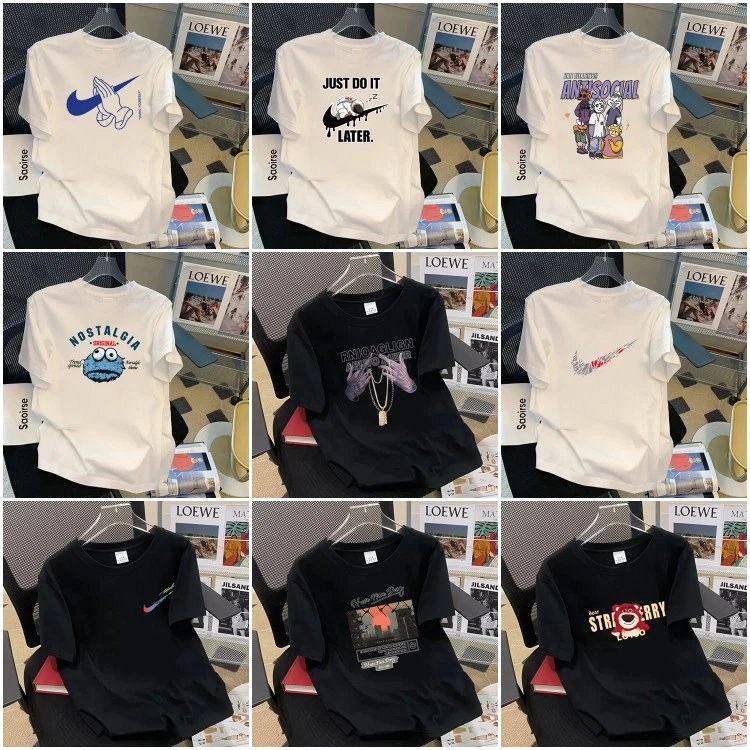
The motif you pick changes how easy the check is. The listing's print themes include swoosh variants, a cartoon bear, a sleeping astronaut, a city sunset and graffiti graphics, all in geometric and cartoon styles. A motif with a hard baseline and a level edge makes misalignment obvious in a photo; a busy all-over print can hide a two-centimetre drift.
Weight, packed volume and the timeline baseline
A tee is the lowest-risk garment you can send through a forwarding warehouse. It flattens, so it contributes almost nothing to volumetric weight — the chargeable figure is driven by actual mass, and textiles compress far better than footwear or boxed goods. A one-item tee parcel usually sits at or near the minimum chargeable weight of an economy line, which is why a first order built around a light garment is the cheapest way to watch a lane behave.
The tee's stated fabric weight of 180 g to under 250 g gives you a narrow expected band per piece, but the listing does not publish a packed unit weight, so the shipping estimate only becomes firm once the warehouse weighs your parcel. That is the first number worth chasing, and the first number we log.
The timeline is the second deliverable. For this order we recorded a timestamp at every handover: payment, domestic seller dispatch, warehouse receipt, QC photo delivery, our approve or reject decision, consolidation, export scan, customs entry and last-mile delivery. Building that chain on a cheap, predictable garment means when something later goes wrong on a heavier haul, you already know which stage of your own workflow loses days.
Where the listing is still uncertain
- Fabric content is stated two ways. The listing names acrylic as the main component and polyester as the fabric name. Those are not the same fibre, and the listing does not resolve which governs the shipped garment.
- No buyer claims describe this listing itself. The fit guidance available is category-level, drawn from other Nike loose-fit tees, not from this item.
- The cut is described as roomy. That is a warning, not a fault — but it means the letter size alone is not enough to order on.
- Colourfastness is a claim, not a photograph. It can only be assessed after the garment is washed.
“When buying T-shirts on the Nike website, make sure to read the ‘Size & Fit’ section in the product description. It will tell you if it's a ‘Standard Fit’ which means go TTS or ‘Loose fit for a roomy feel’ which means it runs big and you should size 1 down.”
That is the clearest buyer-written statement we found on Nike loose-fit tees, from Parallel's sizing guide. Chinese-language buyer guidance on Taobao's Nike sizing page makes a similar point from the other direction: short-sleeve sizing is broadly accurate but varies by line and cut, so shoppers should read the specific item's own measurements rather than assume a letter size behaves the same way across styles. For this order, that translated into asking the warehouse for flat measurements before approval rather than trusting the listing's fit word.
Running it as your control item
- Order one print in both the white and the black short-sleeve version. Two pieces from the same print give you a same-spec comparison and push the parcel closer to a line's useful weight bracket.
- Request daylight QC photos and a tape-measure shot on the chest and body length, then read them against the size you ordered and the stated 1–3 cm tolerance.
- Decide in writing in the QC thread. If you approve, you keep the photos as your baseline. If you reject or request a reship, keep the exact wording of the thread — that record is what tells you how the agent handles disputes next time.
- Log the invoice total, the shipped weight and every timestamp. Those four numbers are what a first order is actually for.
Where the score lands
We rate this 4.2 / 5. As a control item for a first agent order it does nearly everything you could ask: cheap, light, visually checkable, and consistent enough to make your own QC workflow the variable you are testing. The deductions are for the unresolved fibre entry, which we could not settle from the listing, and for the roomy loose cut that keeps the letter size from being a reliable buying decision on its own. Neither is a defect in the garment we received; both are reasons to verify before you approve.
Hands-on score 4.2 / 5