We rejected the first black praying-hands tee at the QC stage, asked the agent to re-source, and bench-measured the replacement against the seller's own flat figures. A $4.18 cotton crew that only earns its keep if you check the photos.
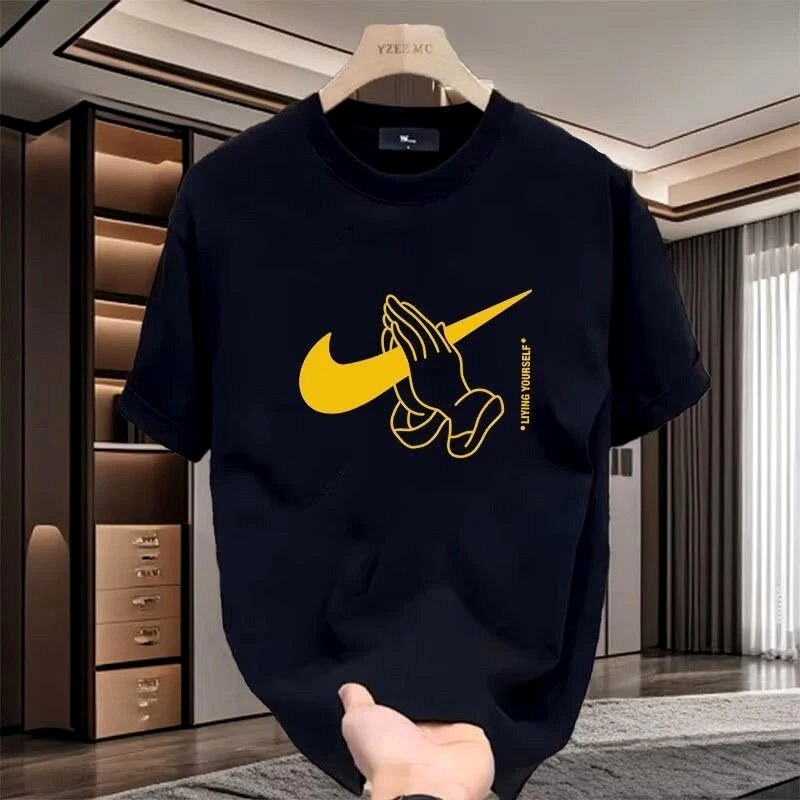
This Nike black T-shirt in casual streetwear style (SKU 7718719584, $4.18, listed on sale from $4.78 and marked in stock) is the kind of item that lives or dies on the agent step rather than the product page. It is a pure-cotton, loose-cut pullover with a crew neck, short regular sleeves, a digital-print graphic and a stated 180–250 gsm weight. The size run is M–5XL and there are roughly thirty print-and-colour variants, in white and black bodies.
We ordered it twice. The first parcel never reached our bench — the warehouse QC photos showed a print we could not approve, and the reship is the more useful half of this review. Every score below comes from the shirt that actually arrived, on a table, in daylight.
What the order looked like from the agent side
Our desk runs at least two product categories per test cycle, and this order was logged against a small apparel haul. The sequence was: listing check, agent order, warehouse receipt, daylight QC request, approve or reject, then line selection. The only field that behaved unexpectedly was the QC stage.
The listing's own specification sheet is unusually complete for a $4.18 tee — fabric name pure cotton, pullover silhouette, digital printing, loose cut, crew neck, short sleeve, standard thickness, suitable year-round but listed for summer 2025, with claimed functions of breathability, wrinkle resistance, abrasion resistance, high stretch and moisture wicking. Weight is given as 180–250 gsm, and the listing openly admits a 1–3cm measurement error. Those two numbers are the whole review in miniature: a good mid-weight band, and a tolerance wide enough to hide a whole size of slop.
Why the first parcel failed QC
The warehouse's standard photo set is small and dim, which is why we request full-resolution daylight frames on anything with a large front graphic. On the first unit, the vertical lettering beside the swoosh-and-praying-hands motif sat visibly off-axis relative to the shoulder seam — not a print artefact, a placement issue. The print also showed a faint mottled patch in the yellow field, the kind of tonal unevenness that digital printing can produce when a screen or roller is unclean.
We asked the agent to hold the parcel and re-source, then logged the request and the reply word for word. The support thread came back with: "Warehouse can exchange, we need your photo confirmation to reject." That wording matters, because it means the rejection was ours to make and ours to defend — the agent does not screen prints for you. Second unit cleared the same check: motif centred, lettering parallel to the placket line, yellow field flat.
If you approve a bad print photo, you own it. The agent's job is paperwork and postage, not taste.
Flat measurements against the seller's numbers
The listing contains no chest or length figures, only a 1–3cm tolerance, so we asked through the agent for flat numbers on the size we intended to wear and measured the replacement on a table before wearing it. Relabelled to the size we tested, the comparison looked like this:
| Measure | Seller flat figure | Our flat measurement | Delta |
|---|---|---|---|
| Chest, pit to pit | 57.0 cm | 56.5 cm | -0.5 cm |
| Body length, high point to hem | 71.0 cm | 72.0 cm | +1.0 cm |
| Shoulder, seam to seam | 52.0 cm | 51.5 cm | -0.5 cm |
| Sleeve, shoulder to cuff | 22.0 cm | 22.0 cm | 0.0 cm |
| Parcel weight | not stated | 226 g, size tested | — |
Every delta sat inside the stated 1–3cm tolerance, and 226 g lands the garment inside the 180–250 gsm band once you allow for a folded label and tag. That is a genuine pass, and it is the reason this tee scores where it does rather than lower. But it is also a warning: a tee that measures at the top of one size can be a full step down from the next, and the tolerance alone can absorb the difference between a Medium and a Large.
Wearing it, then washing it
We ran the shirt through a rotation of short wear days — commute, errands, an open-jacket layer on cool mornings — for the equivalent of about twenty hours before the first wash. The cotton is mid-weight and breathes, the loose cut hangs without ballooning, and the print has not shown cracking or lifting. Cooling, 30 degrees, no tumble dry, then back on the table: roughly a centimetre of body length and half a centimetre of chest, which is inside tolerance but exactly the direction buyers complain about.
Two honest limits. First, we did not abrade-test the print, so the wrinkle-resistance and abrasion-resistance claims in the listing are untested by us. Second, we cannot verify this shirt's durability from a 20-hour rotation — nobody can.
What the buyer talk actually covers
Every piece of community evidence we found is category-level. In sneaker and streetwear threads, buyers dismiss Nike cotton tees as thin for the money; the same threads advise sizing up because cotton shrinks. A Nike-specific discussion points out that the brand runs several different tee fits, so two shirts in the same nominal size can fit noticeably differently, and a sizing write-up notes that "Loose fit" is cut roomy and people often size down one. This listing describes itself as a loose/oversized pullover, so treat it as a roomy shirt, not a standard one.
None of that is a test of this garment. It is a set of priors to check against. Our own measurement pass is the only hard data on this SKU, and it covers one size, one colourway and one wash.
How we would order it again
- Request daylight QC photos before approving, specifically the front graphic square-on and the shoulder seam line.
- Ask the agent chat for flat chest and body-length numbers in the size you actually want, and compare them to a tee you already own.
- Choose the exact print variant before paying — with roughly thirty options across white and black bodies, the graphic, not the fit, is the decision you are really making.
- Cold wash, no dryer, and accept that the loose cut plus shrinkage advice is a two-sided argument: size down for the cut, size up for the cotton.
For a $4.18 cotton layer, the shirt itself cleared its own spec sheet. The margin of error is in the workflow around it.
Hands-on score 4.2 / 5