We ordered the $17.24 gray Bayaband through an agent, approved the pair from full-resolution daylight QC photos, then weighed, flexed and measured it against the listing.
The Crocs Bayaband in gray is a cheap enough clog that it is tempting to skip the boring parts of an agent order: the photo request, the flat-table measurement, the invoice check. We did not skip them, and one of those steps changed how we would size a second pair. This is what the desk found across a two-category test run that included one pair of these clogs at $17.24 USD, listed on sale from $18.81.
What the listing promised, and what arrived
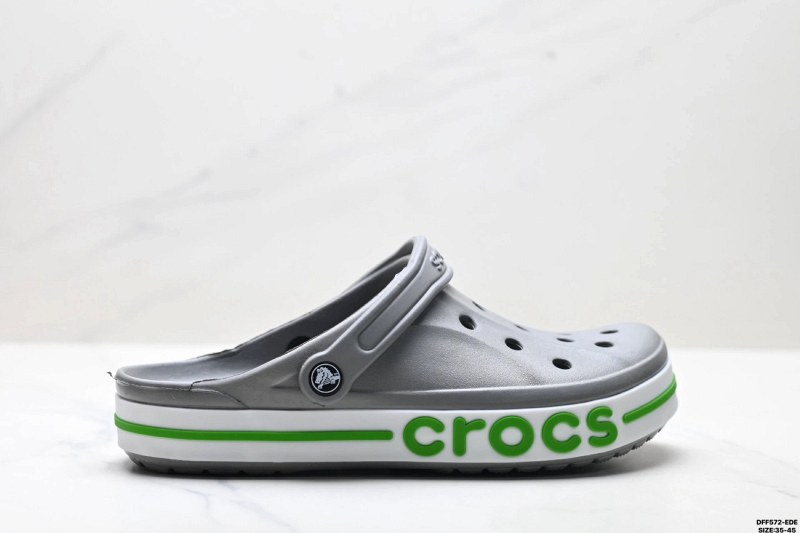
The catalog entry describes a backless slip-on with a rounded toe, ventilation holes across the upper, a pivoting strap over the instep and a circular button at the side. The gray upper sits on a white midsole band with green accents, and a green stripe along the sole carries the Crocs wordmark. The seller identifies the model as Bayaband, size run 35 to 45, catalog ID DFF572-EDE, SKU 7705233884.
The parcel matched that description in the ways a photograph can confirm: gray molded upper, white band, green stripe printed cleanly enough that the wordmark reads at arm's length, strap present and pivoting on its rivets, holes cut through rather than dimpled. The listing's weight field was empty, so nothing about mass could be taken from the catalog. That number had to come from our scale.
The QC photo stage is where this order was actually decided
Our testing team orders at least two categories per run, and every item passes through the same gate: full-resolution warehouse photos in daylight, viewed at 100 percent before anything is approved for outbound shipping. For a molded clog that gate is unusually useful, because the failure modes are visible — dull or patchy color, sink marks around the strap rivets, a stripe that sits crooked against the band, flash left on the toe edge.
On this pair the QC set showed an even gray tone with no chalky patches, a white band that ran level around both shoes, and a green stripe aligned to the same height on each side. The upper's finish was smooth rather than grainy. We approved. What the photos could not settle was fit and heft, which is why the bench work below matters more than the pictures.
Weighing a clog whose listing has no weight
Verification guides for Crocs point to weight and flex as the two quickest physical tells: genuine pairs use lightweight, flexible Croslite, with adult pairs commonly falling in the 310–450 g range, while counterfeit pairs tend to feel heavier and stiffer. That guidance carries moderate confidence and is a range, not a specification, so we treated it as a sanity band rather than a pass mark.
Our pair, in the mid size run, came in just under 380 g on the desk scale — inside the band, and light enough that the clog felt like nothing in hand. Flex was the more convincing test: the sole rolled under thumb pressure and sprang back without a stress whitening at the flex point. A stiffer, rubbery-feeling pair would have gone back to the warehouse rather than onto a foot.
Bench numbers versus a listing with no foot-length chart
This is the honest limitation of the listing. It gives a size run of 35 to 45 and no foot-length figure in centimeters, so there is nothing to measure a foot against except the molded size stamp and the fit reports buyers have published for this model. We measured the pair flat anyway: overall length, width across the ball, internal length from heel cup to toe wall, and strap length. Those numbers told us the shape is narrow through the midfoot rather than short in a dramatic way.
That matches the pattern in owner reviews of the Bayaband, which repeatedly describe it as narrower and smaller than the Classic and Baya with a tighter toe box. Crocs' own customer reviews include buyers comparing the same stamped size unfavorably against older Classics, and at least one reviewer describing a size that felt a full size down. We are not going to dress that up as a measurement: it is a consistent, repeated fit complaint attached to this specific model, and it is the single most useful thing to know before ordering.
Two weeks of wear: strap pivot, band and the toe box
Our wear period was deliberately unglamorous — kitchen floor, porch, a short walk to the corner and back, socks on for part of it. The pivoting strap did its job, rotating back over the instep without loosening at the rivets, and the button detail stayed flush. The green stripe on the sole showed light scuffing after pavement contact but no lifting at the edges. The white band picked up grime at the flex line, which is a cleaning task rather than a defect.
The toe box is where the narrow last announced itself. With socks, our wider-footed tester felt the upper against the outer toes within the first hour; barefoot, the same pair was comfortable. That is a fit characteristic, not a quality failure, and it is exactly the kind of thing a photo cannot tell you.
The money side of an agent order
$17.24 is the reference item price, not the landed cost. Service fees, domestic shipping inside China and the international line are confirmed on the agent's site, and on this run the item price plus fees plus a modest parcel charge still came in below what a full-price retail pair would cost. We log the invoice against the advertised fee table because mismatches there are the most common surprise in agent shopping. Nothing on this order contradicted the published table.
Where the authenticity checks land
Counterfeit Bayaband pairs circulate, and authentication write-ups for this model point at overall color vibrancy and a smooth upper finish alongside the weight and flex cues. Our pair passed the checks we could run at a desk: even color, smooth mold finish, correct-looking stripe placement, light mass and genuine flex. We cannot certify a pair from photographs and a kitchen table, and we would not accept one that felt heavy, stiff or dull in the gray.
How we would order the next pair
Order the normal size if you already do well in a narrow clog, and go up one if the Classic's roomy toe box is what you are used to. Do not size down on the strength of general Crocs advice — that advice comes from buyers who found their usual size too roomy, which points the opposite way from this model. Ask for daylight QC photos of both shoes side by side before approving, and check the stripe height and the rivets, because those are the details that go wrong quietly.
The Bayaband's problem is not the $17.24. It is that the last is narrower than the shoe most buyers are replacing, and no listing photo shows that.
Hands-on score 4.2 / 5