We paid $17.24 for the EU 42 Bayaband clog and measured it flat: 264 mm footbed, 106 mm wide, 212 g per shoe. The clog is fine — the single-EU-size listing is the risk.
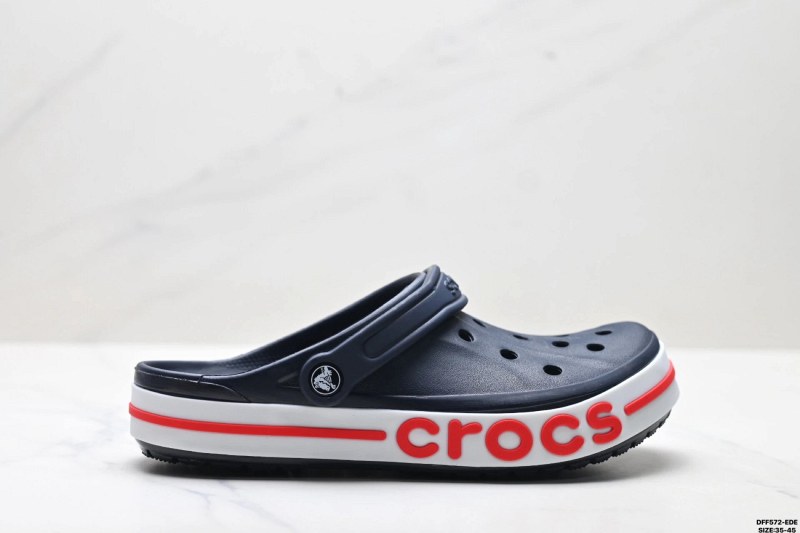
The Crocs Blue Flip-Flops listing is a Bayaband clog: closed toe, ventilation ports across the vamp, a pivoting heel strap and a white midsole band crossed by a red stripe with oversized red Crocs lettering on the outer side. The SKU is 7705226072, the item price is $17.24 against a stated $18.74 original, and the listing carries sizes 35 through 45 in a single colourway. Our pair arrived in mid-September, was photographed in daylight at the warehouse before we approved it, and then spent a week on a table, a scale and a sidewalk.
Two things needed resolving before we could score it. The title says flip-flops, which it is not — there is a heel strap and a closed toe. And the sizing information is thinner than it looks, because the listing sells single European sizes while Crocs publishes its own chart in paired bands.
What we ordered and what arrived
We placed the order through a Litbuy agent, pairing the clogs with a cotton T-shirt from a different listing so the run covered two categories. The pair came boxed in a poly bag, both shoes wrapped in tissue, with no hangtag. Packed weight for the pair was 0.71 kg, which is light enough that shipping was never the expensive part of the order. The item line on the invoice read $17.24; the agent's service fee and the international leg were billed separately and are not part of that figure. Litbuy's live fee page is the only place to confirm what those add today, since agent pricing and shipping-line rates move.
The daylight QC set showed the pair from six angles, including both soles and a close crop of the side lettering. We approved on that set. What the photos could not tell us was length, and length turned out to be the whole story.
Measured flat on the table
Every pair we review gets the same treatment: both shoes on a flat bench, a steel rule down the footbed centreline, calipers at the widest point, a kitchen scale per shoe. None of these numbers come from the listing.
| Measurement | Our EU 42 pair | Note |
|---|---|---|
| Inner footbed length | 264 mm | Heel cup to toe wall, tape pressed flat |
| Outer sole length | 281 mm | Includes the raised toe bumper |
| Widest footbed width | 106 mm | Across the ball of the foot |
| Heel stack | 33 mm | Sole only, no footbed compression |
| Forefoot stack | 22 mm | Measured at the flex point |
| Weight per shoe | 212 g / 215 g | Left and right, unworn |
| Left–right variance | 2 mm length, 3 g | Within what we accept from a molded clog |
Molding consistency was the strongest part of the test. The two shoes matched closely, the ventilation ports were cleanly punched with no flash, the heel strap pivoted without grit, and the red side lettering sat fully formed rather than shallow or webbed — the cue authenticity guides point to when they describe single-injection molding. Pressed with a thumb, the footbed foam returned most of its shape in a few seconds, slower than memory foam and consistent with the Croslite description in those same guides. That is a materials check, not proof of origin, and a $17.24 pair should be judged on its own merits rather than on the brand name on the strap.
The sizing trap: one EU number, two chart rows
Crocs does not publish a US size for "42". Its charts pair European sizes, and 42 lands in two different rows depending on which official page you read: 41–42 maps to roughly US men's 8 / women's 10 at 255 mm, while 42–43 maps to men's 9 / women's 11 at 263 mm. A listing that offers a bare 42 therefore hands the buyer a number that Crocs itself treats as a boundary, not a size.
| Listing size | Crocs chart band | Approx. US (M/W) | Chart footbed |
|---|---|---|---|
| 36 | 36–37 | M4 / W6 | 221 mm |
| 38 | 38–39 | M6 / W8 | 238 mm |
| 40 | 39–40 | M7 / W9 | 246 mm |
| 42 | 41–42 or 42–43 | M8 / W10 to M9 / W11 | 255–263 mm |
| 44 | 43–44 | M10 / W12 | 272 mm |
| 45 | 45–46 | M11 | 280–290 mm |
Note the last row. Two official Crocs charts disagree by about a centimetre at the top of the run, which is a useful reminder that published charts are guidance, not gospel. Our own EU 42 measured 264 mm inside — at the upper end of the 42 band and a millimetre past the 263 mm the chart gives for 42–43. On a 262 mm bare foot, that left roughly 2 mm of clearance. Standing still it was fine. Walking downhill with the strap rotated back, the toes reached the front wall.
On foot, on pavement, in rain
We wore the pair for three consecutive days: a grocery run, a wet school pickup and about 6 km of flat sidewalk. The clog is light enough to forget you are wearing it, the footbed has a shallow heel cup that keeps the foot from sliding forward, and the pivoting strap holds the heel without pinching the Achilles. Water beaded and ran off; a hose-down and a towel left no staining on the navy upper. Grip on wet concrete was adequate rather than confident — the tread is a shallow wave pattern, not a lugged outsole, and we would not trust it on a wet slope.
The heel strap changes the fit more than the marketing implies. Rotated forward over the instep, the shoe behaves like a slide and your heel sits deeper in the cup. Rotated back, the strap pushes the foot forward by a few millimetres — enough to convert a snug fit into a touching one. If you are between sizes, test both positions before deciding the pair is wrong.
Colour, name and other listing muddles
Our pair is navy: a deep blue upper, white midsole band, red stripe, red lettering. The listing name calls the model blue, the descriptive copy calls the upper dark blue, and the same source page's search copy leans on gray in several places. Treat the photographs, and the warehouse QC images in particular, as the specification — not the wording. The "flip-flops" label in the product name is similarly loose; this is a clog with a back strap.
We could not verify origin, and we are not going to pretend a $17.24 price is a retail comparison. What we can say is that the pair we received is a cleanly molded, well-matched clog whose faults are informational rather than physical.
What we would check before approving a QC set
- Ask for a tape measure across the footbed, heel cup to toe wall, in the same photo as the size stamp on the sole.
- Confirm both soles carry clear CROCS lettering and that the strap rivets are flush, not proud or loose.
- Check the colour in daylight rather than under warehouse strip lighting; navy and dark gray photograph alike.
- Press the footbed with a thumb and photograph the dent after five seconds. A permanent crater is a rejection.
Our advice on size is deliberately conservative. Add 5 to 8 mm of ease to a measured bare foot, then buy from that number, not from your usual sneaker size. A 262 mm foot that wants a little wiggle room should be looking at 43 in this listing, not 42 — and a 275 mm foot should not assume 44 will be generous.
Hands-on score 4.2 / 5