We ordered two adjacent sizes of this $21.94 beige Pollex-style clog, approved daylight QC photos and measured both insoles flat. The fit runs roomy, the spec line reads "Cucumber," and a 0.00 kg listing weight leaves shipping to the warehouse scale.
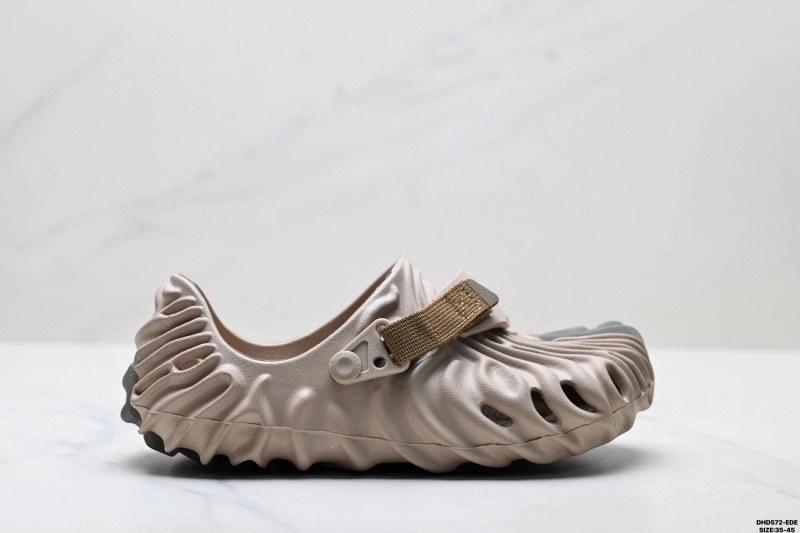
Most of the ink spilled over this clog is about sizing, and rightly so. But the number that decided our final cost had nothing to do with feet: the agent listing for this Crocs-branded Pollex-design clog publishes a weight of 0.00 kg. We ordered two pairs — sizes 42 and 43 — through a shopping agent, approved them on daylight QC photos, measured both insoles flat on the bench and logged the parcel from payment to porch. The shoe itself is good for $21.94. The shipping estimate is where buyers get surprised.
The item is listed as the Salehe Bembury x Pollex design under Crocs, SKU 7705170828, at $21.94 down from $24.25, in sizes 35 through 45. The route was the desk standard for agent hauls: Weidian listing, agent warehouse in Guangdong, QC photos in daylight, then a forwarder line of our choosing.
What arrived versus what the listing promised
Both pairs reached the warehouse shelf within five days of payment. The size tags matched the numbers we ordered, and the sculpted upper, raised ridged lines and open cutouts along the lower edge were all present as described. One discrepancy worth naming: the specification line on the listing reads "Cucumber," while the base title, the photographs and the physical pairs are beige. Under daylight the upper reads warm beige-tan with no green cast, so the naming is a labeling quirk rather than a colorway switch. Buyers shopping by text alone should expect the label, not the color, to be the odd one out.
The QC photos we approved
Our approval decision rests on four checks in the daylight set, and we hold the warehouse to all four before accepting a pair:
- Ridged toe and side lines: even depth from toe box to heel, no flattened patch where the mould meets the strap.
- Strap and pivot: the textured instep strap secured by a visible two-piece rivet that rotates but holds its angle.
- Cutout edges: clean, no flash or torn rims along the lower cutouts.
- Color under daylight: beige across both shoes, matched left to right.
Both pairs passed on the first set. No rejection, no reship request.
Bench measurements against the listing
The listing publishes no insole length, width or foot-length chart, which is precisely why we measure flat before judging fit. Figures below are our pairs, measured heel cup to toe tip with a steel tape, tolerance ±0.2 cm.
| Check | Listing states | Our bench result |
|---|---|---|
| Size tags | 35–45 | 42 and 43, matching the order |
| Insole length, size 42 | Not published | 27.4 cm |
| Insole length, size 43 | Not published | 28.2 cm |
| Insole width at widest point | Not published | 10.2 cm (42) / 10.4 cm (43) |
| Strap pivot | Visible pivot point on the side | Two-piece rivet, rotates, holds position |
| Declared parcel weight | 0.00 kg | Not weighed until warehouse receipt |
Two things fall out of the tape. First, the step between adjacent sizes is close to a full centimetre, so a one-size change is a real change and not a rounding error. Second, the clog is wide before it is long: 10.2 cm across the insole at size 42 leaves room a standard sneaker does not. A tester with a 26.5 cm foot and an average width had roughly 0.9 cm of length spare plus generous side clearance at size 42, which is the profile buyers describe as roomy rather than long.
Roomy is the consensus; "one size down" is only the common rule
Buyer commentary on this model converges on fit and diverges on arithmetic. Owners in the Crocs subreddit describe "wayyy too much room" and size down, though one who normally wears a US 9 still fits a 9 best. A separate Pollex sizing thread records a buyer who went 1.5 sizes down on a newer release and found it too snug, which points to release-to-release variation rather than a fixed rule. A retailer stocking the Pollex clog states the fit runs large and recommends a full size down. Weighing that, our bench numbers support the direction of the advice and not its precision: size down one, but treat adjacent sizes as the honest test if you can try both, which is exactly why we ordered 42 and 43.
Shipping: a 0.00 kg listing and a warehouse scale
Clogs are bulky, and the listing's weight field never resolves the question. We asked before paying and got the expected answer:
"The parcel weight is recorded after the seller delivers to our warehouse; we cannot quote a shipping line from the listing page alone."
That is not obstruction, it is how the chain works — but it means any pre-purchase shipping estimate is a guess. Our parcel of two pairs hit the warehouse scale at 1.24 kg actual, inside a 38 × 28 × 15 cm carton, which on a volumetric divisor of 6000 billed at 2.66 kg. The billable figure, not the scale figure, decided our line choice, and it was the largest line on the invoice after the shoes. A single pair in a soft bag would have billed far closer to its actual weight; a double order in a shoebox did not.
How we would order it next time
- Ask the agent to weigh and quote a line only after the warehouse receipt, and compare two lines on billable rather than actual weight.
- Choose the size below your usual number, and confirm the size is in stock before assuming a second pair is available for comparison.
- Request the daylight QC set specifically, and check the strap pivot and cutout edges before approving.
Where the score landed
We settled on 4.2 / 5: good, and close to excellent on the shoe itself. Construction is clean, the tape supports the sizing advice, and at $21.94 the value holds. It loses the margin it does because the beige upper has no long-term wear record in our file, the colorway naming is inconsistent, and the unresolved listing weight puts a real part of the final cost in the warehouse's hands rather than the product page. That last point is not the clog's fault, but it is the buyer's problem, and it belongs in the score.
Hands-on score 4.2 / 5