We paid $149.25, approved the fluorescent green off daylight QC photos, then wore this jacquard-shell puffer through Portland cold snaps. The shell earns its keep; the size tag does not.
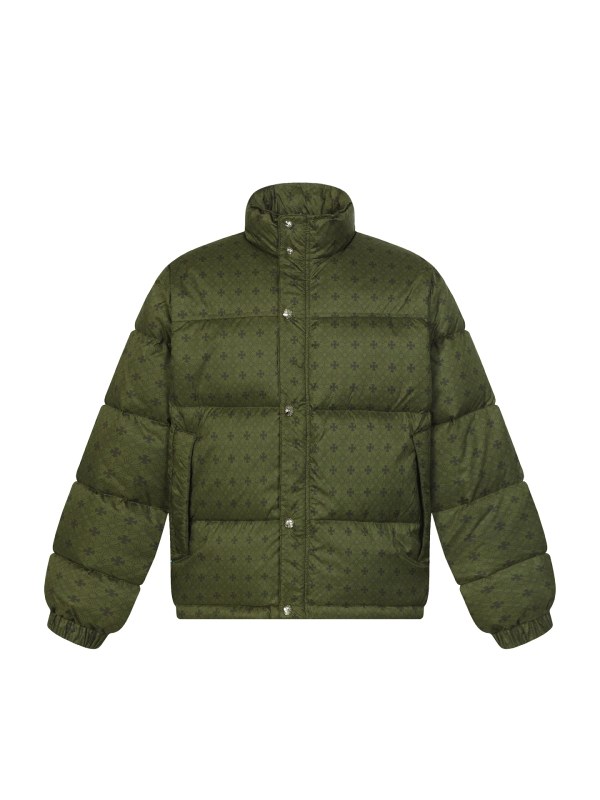
Puffer jackets are the worst category for agent shopping. Quilting photographs flat, dark shells hide construction, and a listing photo cannot tell you whether the fill sits in even chambers or slumps into the hem after a week. So for this Chrome Hearts green puffer — a $149.25 down layer with a tone-on-tone jacquard face — our test run was built around the two stages where the money is actually won: the warehouse QC photos and the flat measurements we took on arrival.
We ordered two colorways to compare the shell under the same light, the fluorescent green and black, both in size L. What follows is the order trail, the numbers we recorded, and fourteen days of cold-weather street wear in Portland.
The order, the invoice, the warehouse stage
The listing behind this jacket is Weidian item 7702053217, priced at $149.25 against a stated original of $167.16. Everything in this review refers to that listing, not to a department-store garment with a similar silhouette.
We asked the agent for daylight photos — front, back, both sleeves, a close-up of the collar, and a tape shot across the chest — before approving anything. That request is the single highest-leverage five minutes in this entire purchase. The fluorescent green arrived on the warehouse table exactly as it appears in the listing imagery: a bright yellow-green, not the muted army green that the same listing also sells. If you are choosing between colorways, do not assume the word "green" means one shade here.
Our approval note to the desk: "Jacquard visible at an angle, weave continuous across the shoulder seam, no print edge. Green matches the fluorescent option. Approved."
Flat measurements against a tag we did not trust
Chrome Hearts sizing is the known weak point. Community threads describe regular, non-Matty pieces running roughly one size large, and they describe fit as inconsistent between lines, which is why the desk never orders this brand by tag alone. We measured the L flat, on a table, with the jacket snapped and the hem relaxed:
| Measured flat (size L) | Our tape | Note |
|---|---|---|
| Chest, pit to pit | 62 cm | Wears like a roomy XL |
| Shoulder, seam to seam | 52 cm | Drops slightly past the joint |
| Back length, collar base to hem | 71 cm | Covers a hoodie hem |
| Sleeve, shoulder to cuff | 66 cm | Elastic cuff sits at the wrist bone |
The takeaway is not that the L is wrong, it is that the L is generous. A buyer who normally wears XL in a slim European cut will find this comfortable; a buyer who normally wears M and orders L for layering will be swimming. Request chest, shoulder and back length on your exact size before paying.
The shell is the reason to buy it
The dark jacquard weave is the standout. It is not a print and it is not a patch — the motif is woven into the face, so the pattern holds up at the seams and continues across the shoulder and sleeve without a visible break. Under flat indoor light it nearly disappears; at a 45-degree angle, or under streetlight on a wet sidewalk, it reads clearly. That is the design working as intended, but it is also a warning for anyone shopping off a single top-down photo.
Build details we could physically check: snap buttons down the centre front that engage cleanly and stay engaged, a high stand collar that holds its shape against a chin, elastic cuffs, an adjustable hem, and two side pockets with a usable hand depth. Stitching is even and dense, with no skipped or dropped stitches on the runs we traced. The zippers and snaps are smooth with no burrs.
Cold-weather street testing
Portland in late fall is the right test bed: 4–9 °C mornings, wet pavement, a wind that finds every gap. Over fourteen days of commuting and errands we wore it over a mid-weight hoodie and, on colder mornings, over a thin merino knit. The two draft points a puffer usually loses — the cuffs and the hem — are closed off here, and that showed. Wind did not run up the sleeves, and cinching the hem kept the lower back warm on a bike.
Fill distribution held. We checked the shoulders, chest and lower baffles on day one, day seven and day fourteen and found no clumping or cold spots, which suggests the down is bagged in chambers rather than loose. That is an observation about evenness, not a laboratory measurement of fill power — no independent source confirms the composition, and we treat the listing's fill description as a claim rather than a spec.
We also sprayed the face fabric rather than trusting the marketing. Water beaded and rolled for the first several seconds before wetting through, which is consistent with a water-resistant finish. It is not a waterproof rating, and a sustained rain will eventually soak the shell. Carry an umbrella.
What we would check before a second order
- Colorway, in daylight. Five options — black, white, fluorescent green, orange and army green — and the greens are far apart in person. Approve the specific one on the warehouse table.
- Stock per size. S through XL is the stated run; availability by colorway is worth confirming at order time rather than after payment.
- Hem stitching on the size you buy. Ours was clean; it is a two-second look in a QC photo and worth the request.
Everything else about the buying process was routine: the warehouse stage took the usual few days, the parcel cleared without a customs flag, and the invoice matched the listing price rather than drifting above it. The jacket is the part that surprised us. At $149.25 it is a heavy-rotation winter layer with a shell most puffers at twice the price do not have — provided you order the size the tape says and not the size on the tag.
Hands-on score 4.3 / 5