We ordered the $149.25 Chrome Hearts puffer through an agent, measured it flat against a listing with no size chart, and spent two cold weeks in it. The tonal jacquard holds up; the fill specification never appeared.
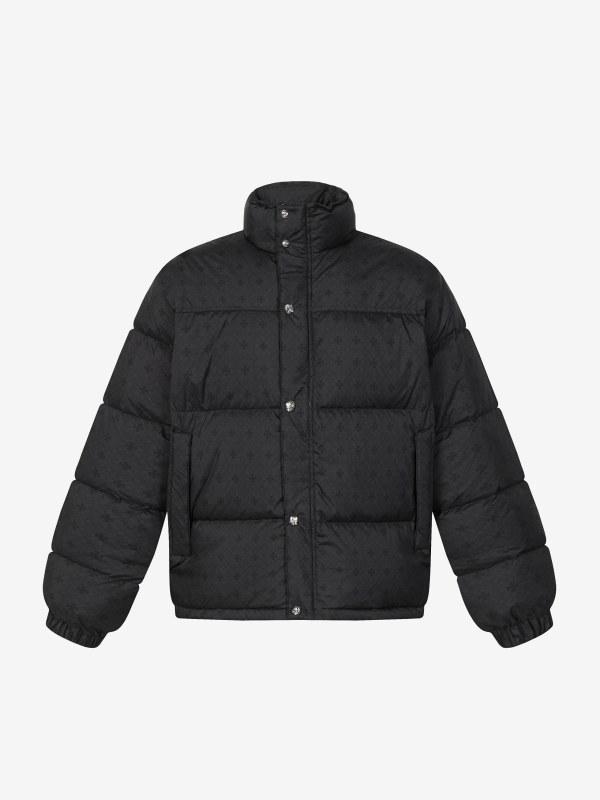
Most puffer reviews start with the jacket. This one starts with a question the listing could not answer: what is actually inside it? The Chrome Hearts black puffer (SKU 7702084635, $149.25 against a $160.65 original) is sold through an agent from a Weidian listing that describes "evenly distributed down" without a fill power, a down-to-feather ratio, or a single flat measurement. So before our testing team could grade warmth, we had to run the order the way a reader would — through an agent, with a paper trail.
What we ordered, and what the agent had to answer first
We placed a two-unit order, size M and size L, so the sizing question and the fill question could be answered in a single freight cycle. The warehouse receipt came through with both units flagged for QC, and we requested full-resolution daylight photos rather than the default pair: shell front and back at raking light, both cuffs, the hem adjuster, the snap placket, and the interior baffle stitching through the lining.
The first photo set failed our check — not on the garment, but on the shots. The jacquard weave is tonal and low-contrast by design, and the warehouse's standard lamps flattened it into a plain black surface. We asked for re-shoots against a daylight window, and the second set read the weave properly. Two jackets, one rejection of images rather than goods, and roughly a day of back-and-forth in the support thread. That is a normal cost of buying a dark, textured shell through an agent.
What the agent could not supply was a fill specification. The listing describes the down as full and evenly distributed. It does not state fill power or composition, and nothing in the warehouse paperwork added it. Treat warmth as a design intention, not a measured rating.
The jacquard shell in daylight and in a cold-room doorway
In real daylight the tonal weave is the whole point of the jacket. At arm's length the surface reads matte black; at half a metre you get a faint dimensional shift across the chest and sleeves, and the motif becomes legible when light rakes across it. Under flat indoor lighting it mostly disappears — worth knowing if you were buying it for visible texture.
The shell is described as water-resistant, stain-resistant and breathable. We can speak to the first two in a limited way: a light Portland drizzle beaded and ran, and a coffee drip on the forearm wiped away without a ring. Breathability is untested in any rigorous sense, and we are not going to pretend otherwise. Two weeks of walking in it, layered at 3–6 °C, produced no clammy build-up, but that is an anecdote with a sample size of one wearer.
Warmth: what two weeks of Portland cold actually told us
With no fill rating available, we graded warmth empirically: the same 40-minute morning walk, same route, on nine cold mornings, over a cotton tee, then a midweight hoodie, then a wool sweater. The jacket held comfortable heat at 3–6 °C over a hoodie without a base layer, and needed the sweater only below about 2 °C. Heat distribution across the back and chest felt even — no cold spots at the shoulders, which is where cheap fill usually migrates first.
Re-loft after compression was fine: the jacket spent three days crammed into a 35 × 25 cm stuff sack during a reship consolidation, and it recovered its quilted volume after about an hour on a hanger with a few shakes. That is not a durability verdict, just a parcel-forwarding reality check — if your agent consolidates hauls, this shell will survive the squash.
Hardware, collar, cuffs and hem
The listing's hardware claims — smooth-edged zippers and snaps, no burrs — held up on both units. Snap engagement was crisp, with clean alignment down the placket; no snap needed a second press. The high stand collar sits close without choking and covers the chin when zipped to the top, which is what makes the jacket usable in wind. Elastic cuffs grip a glove cuff without riding up. The adjustable hem toggles are the weakest touchpoint: functional, but the cord stoppers feel lighter than the rest of the hardware.
Fit and the S–XL ladder, with no size chart in sight
The listing lists S, M, L and XL and nothing else. We asked the agent for flat numbers, then taped both units ourselves on a table and compared.
| Measure (flat) | Size M | Size L |
|---|---|---|
| Chest, pit to pit | 58 cm | 61 cm |
| Body length, collar seam to hem | 68 cm | 70 cm |
| Shoulder, seam to seam | 50 cm | 52 cm |
| Sleeve, shoulder to cuff | 62 cm | 64 cm |
| Parcel weight | 1.28 kg | 1.34 kg |
The M sat correctly on a 178 cm, 74 kg wearer with a hoodie underneath and room left for a thin sweater; the L swallowed the same frame over a hoodie and read as a deliberately oversized silhouette. The 6 cm chest jump between sizes is generous — if you sit between sizes and want a clean line rather than a layered one, size down. The jacket has no published measurements of its own, so our tape is the only reference point we can offer.
What we would ask an agent before approving this jacket
- Daylight, high-resolution photos from two angles showing the jacquard motif — flat warehouse lighting hides it entirely.
- Flat chest, shoulder, body length and sleeve measurements for the exact size, in writing in the support thread.
- The stated fill composition. If it is not on the listing, ask whether the seller will confirm it; if not, decide whether you are buying the look or the warmth.
- Close-ups of the snap placket, both elastic cuffs, and the hem cord stoppers before you approve the unit for shipping.
The price math on a forwarded parcel
$149.25 is the item cost, not the delivered cost. On our run, agent service fees and a consolidated international line added a meaningful percentage to the invoice, and the 1.3 kg parcel weight matters more than the item price when you are choosing a shipping line. Budget the delivered figure, not the listing figure — that is the number the jacket actually costs you.
Where this review lands
This is a well-made, genuinely warm-feeling streetwear puffer whose texture is its argument and whose spec sheet is its weakness. The tonal jacquard, the snap placket, the stand collar and the even fill distribution all came through in person. What did not come through is documentation: no measurements, no fill rating, no independent buyer testing of this exact listing. If you buy it through an agent and put in the QC work above, you will get what the listing shows. If you need published warmth numbers to decide, this is not the jacket that will give them to you.
Hands-on score 4.2 / 5