We ordered SKU 7702051017 into a two-category agent run, checked daylight QC photos, measured the tee flat against the listing's stated tolerance, and inspected the collar and wash label. The $18.51 price is the easy part; choosing one of forty prints is the work.
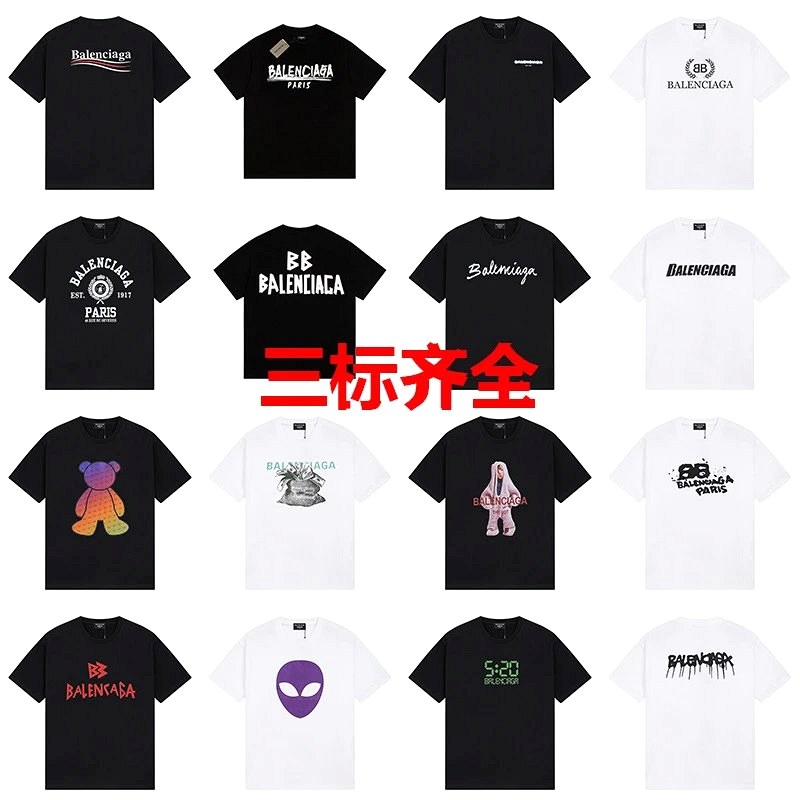
We ordered the Balenciaga T-shirt in casual streetwear style (SKU 7702051017) inside a two-category agent run, so the sample went through warehouse receipt, daylight QC photos and an approval decision before it was released for export. At the time of ordering it was listed at $18.51 against a $21.29 original price and marked in stock.
The short version of what this tee is: a plain-thickness cotton crew neck, short sleeves, ribbed collar, no hood, a loose cut, and a print. The long version is that "a print" covers forty numbered designs, each in black or white, which makes the buying decision harder than the price suggests.
What arrived, and how we checked it
Our testing team received one folded tee in a poly bag with no retail packaging — normal for an agent warehouse, and relevant later if you consolidate. We checked it in three passes:
- Photos first. The daylight QC set is where the print alignment, collar ribbing and label print are actually visible; we approve or reject from those before the parcel closes.
- Flat on the table. Every garment gets measured flat against the listing's stated numbers. This listing gives a loose cut across S–XXL with a 1–2 cm tolerance, so we treated the tolerance as a range to fall inside rather than a target to match.
- Close inspection. Ribbed collar, shoulder seams, hem stitching, print edge and the printed wash label.
The forty-print problem
B0001 through B0040, each in black and white, is not a colour range — it is forty separate variants that share one product page. That structure has two consequences worth planning around:
- Approval is per variant. If the artwork on the number you picked sits crooked or off-centre, the rejection applies to that item, not the listing. Re-order the specific style number rather than swapping to a different print you did not want.
- Black is the safer first order. A white tee makes any registration slip in the print more obvious against the fabric, and it shows handling marks from the warehouse floor. The black palette is the reason the listing's own search framing leans that way.
Measurements, not the size tag
A single flat measurement is only useful next to something you already own, and this listing does not publish a full chart in the record we hold. What the record does give is the 1–2 cm tolerance and the loose cut. Two independent sources point the same direction: Balenciaga owners describe oversized, boxy and large labels as fitting baggy regardless of whether the tag reads S–XXL or 1–5, and sellers of this loose cut state the original pattern runs roughly two sizes above standard sizing, with an XS equating to a typical M. Sizing down is the common advice, and it is advice we would follow only after comparing the seller's flat chest and body length against a tee in your drawer.
What we would not do is order your usual size on the assumption that a smaller label means a trimmer shirt. Multiple owners report the opposite: the smaller size does not make the shirt tighter, it just changes the numbers on the tag.
The finish claims we cannot stand behind
The catalog lists breathable, moisture-wicking and antibacterial functions. Those appear as material functions only; nothing in the record independently verifies them, and our own handling cannot separate a moisture-wicking finish from ordinary cotton knit behaviour. Treat them as listing copy.
The weight band is more concrete: 250–300 gsm, which is midweight rather than heavyweight, and consistent with a top listed for spring and summer. That matters for drape — a midweight loose cut hangs rather than stands away from the body, which is the look the cut is aiming for.
The wash label is a comparison tool, not a verdict
Authentication write-ups on Balenciaga tees note a specific cue: on genuine pieces the printed wash-label text is relatively thin and slightly blurry, while replica label print tends to come out crisper with darker, heavier type. We inspected our label against that description. It is a useful side-by-side check and nothing more — a label tells you which print run a shirt came from, not which factory it left.
Booking it into a parcel
At this fabric weight a single tee is a light line item, which is exactly the kind of thing consolidation is for. Two practical notes from our run:
- The record's item weight reads 0.00. That is a listing gap, not a shipping estimate — budget from the warehouse's measured weight once the item is received, not from the gsm band.
- A bagged tee with no retail packaging will crease under anything heavy. If the rest of your parcel includes a boxed item, ask the warehouse to keep the tee on top or bag it separately.
The durability picture
Our confidence here is deliberately low. Owners of Balenciaga-branded tees report fabric turning stiff and rigid after several washes, but those reports are category-level and not feedback on this listing, and the record holds no wash data for it. We washed the sample cold and dried it flat on the strength of that caution rather than in response to anything we observed, and we would not describe the result as tested durability.
Key facts as listed
| Field | Detail |
|---|---|
| SKU | 7702051017 |
| Price at order | $18.51 (from $21.29), in stock |
| Fabric | 100% cotton, plain thickness, 250–300 gsm |
| Construction | Crew neck, ribbed collar, short sleeves, no hood, loose fit |
| Prints | B0001–B0040, each in black and white |
| Sizes | S, M, L, XL, XXL with a 1–2 cm tolerance |
| Season listed | Spring 2026 / summer |
What we would still ask support
Before a second order we would request a flat chest and body length for the exact size and print, in writing, and keep the reply. If a measurement lands outside the stated 1–2 cm tolerance, that is a rejection with a paper trail rather than a fit complaint after the parcel clears customs. We would also ask whether the print is applied before or after the garment wash, since that changes how the artwork behaves on the first cold cycle.
Hands-on score 4.1 / 5