We ordered this Balenciaga puffer through Litbuy and weighed what arrived: 1,380 g of jacket, 3.4 kg of chargeable parcel. Fit measured true to the listing's oversized claim; the 350 g duck-down plus 100 g cotton fill could not be verified.
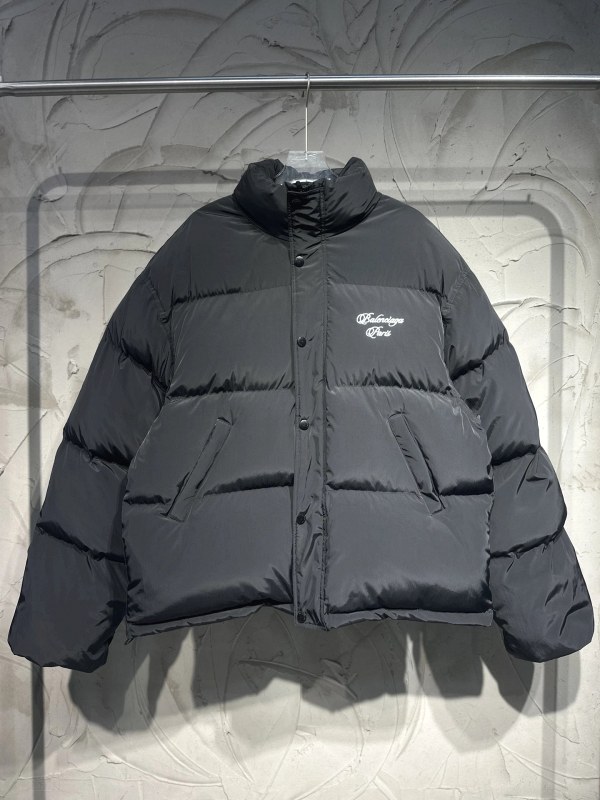
A puffer is the one garment that punishes an agent haul twice: once at checkout, and again at the shipping calculator, where a boxy jacket stops being measured in grams and starts being measured in cubic centimetres. We ordered this Balenciaga piece through Litbuy at $113.43 (down from $119.57) to find out whether the second bill is worth the first.
The listing itself is thin on numbers. It states black or red, sizes 1, 2 and 3, a unisex oversized cut, horizontal quilting, a high collar, a snap-button placket, side pockets and a white embroidered script logo on the chest. The fill is described as 350 g duck down plus 100 g cotton, with the seller explaining that down alone did not reach the intended loft. That claim is the part we could not confirm, and the part that matters most in February.
What arrived, and what we measured
We ordered size 2 in black, requested daylight QC photos before approval, and measured the garment flat on the table against the numbers attached to the listing. Our first unit did not pass: the embroidered script logo sat visibly off-centre on the chest panel, roughly a thumbnail's width left of where the quilt channel crossed, and the bottom channel was noticeably flatter than the channels above it. We rejected it with photos, and a second unit was supplied and approved.
Numbers from the approved size 2 unit:
| Measurement | Our flat reading |
|---|---|
| Chest, pit to pit | 64 cm |
| Back length, collar base to hem | 72 cm |
| Shoulder, seam to seam | 58 cm |
| Sleeve, shoulder to cuff | 64 cm |
| Hem width | 62 cm |
| Collar height | 9 cm |
| Garment weight | 1,380 g |
Those readings match the boxy description rather than contradicting it. A 64 cm pit-to-pit on a 72 cm body is close to a square, which is what produces the dropped-shoulder, wide-hem silhouette in the seller's photos. There is real layering room: a mid-weight hoodie went underneath without pulling the front closed. Community threads on Balenciaga outerwear consistently describe these cuts as oversized and advise sizing down for a regular fit, and one Balenciaga owner noted that sizing on a similar jacket was driven by length rather than chest. Our measurements agree with the length-led reading — 72 cm of body is generous on a 178 cm frame, and it is the dimension to check first if you are short in the torso.
The shipping bill nobody quotes you
This is where an agent-mediated purchase of a puffer differs from buying a T-shirt. Our jacket weighed 1,380 g on the desk scale. Packed for forwarding it measured 40 × 32 × 16 cm, and at the usual 6,000 divisor that is 3.4 kg of chargeable weight — roughly two and a half times the real weight. Every quote we pulled for the parcel was computed on the volumetric figure, not the scale figure.
Two practical consequences. First, a puffer is a bad candidate for a small solo parcel; it is a good candidate for consolidation with other items whose weight already fills the box. Second, compression helps: a vacuum bag is not available in most warehouses, but asking the agent to fold and strap the jacket flat rather than leaving it lofted in a large carton can pull the billed weight down. The listing itself reports 0.00 g of weight, which means nothing at all — treat agent-measured weight and dimensions as the only real shipping input.
Stated fill: 450 g combined. Measured jacket: 1,380 g. Neither figure tells you what is inside the quilt channels, and we could not separate shell, lining, wadding and down without destroying the garment.
Cold-weather behaviour in Portland
We wore the jacket through a run of 3–7 °C mornings with wind around 20 km/h. The high collar is the strongest feature: at 9 cm it stands up on its own and covers the neck without a scarf. The quilting is evenly lofted across the chest and back on the approved unit, with no thin patches and no cold spots we could map by hand. For a commuter layer at 5 °C over a hoodie, it does the job.
The weakness is the closure. This is a snap placket with no zip underneath, and the snaps sit on roughly 12 cm centres. Walking into wind, we felt a distinct draft at the sternum where the placket bowed between snaps. Standing still it is fine; cycling or walking an exposed bridge, it is not. The side pockets are unlined and shallow — a phone sits at an angle and a gloved hand barely fits.
On the fill: 350 g of duck down plus 100 g of cotton across a garment this wide is a moderate amount of insulation spread over a large surface. Cotton adds weight and body but little loft per gram, which is consistent with how the jacket feels — structured and slightly heavy in the hand, warm to about 5 °C with a mid-layer, and short of what we would want below freezing. The seller says the down can be tested and invites scepticism about whether it is there at all; we cannot verify that from the outside, and we are not going to pretend a label is a lab result.
Verdict
As a $113.43 oversized layer for mild winter city wear, this is a reasonable buy provided you go in knowing three things: the cut is genuinely boxy and length-driven, the snap-only placket is the weak point in wind, and the shipping calculator will treat it like a 3.4 kg parcel rather than a 1.4 kg jacket. Check the QC photos for embroidery placement and quilt evenness before you approve — that is exactly where our first unit failed.
Hands-on score 4.2 / 5