We ordered the $137.31 Arc'teryx white shell through an agent, taped it flat, put it under a shower and wore it for three wet weeks. The fit is good; the white is the commitment.
By Priya Raghavan, Reviews Editor
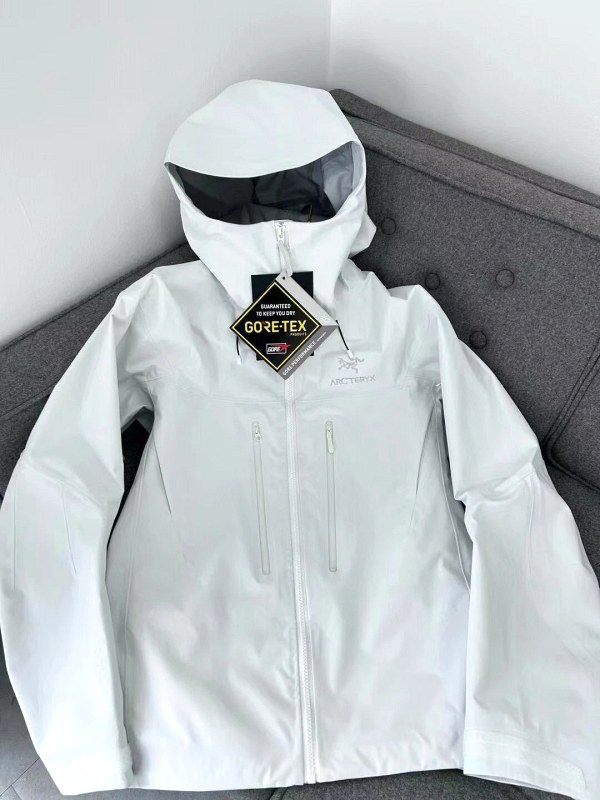
The white Arc'teryx hard shell is the kind of item that makes a shopping agent worth the paperwork, and also the kind that punishes you for skipping the paperwork. It is listed at $137.31 USD against a $154.90 reference price, in polar white, across S–XXL, with a GORE-TEX tag sitting at the front zip and two vertical chest pockets. That tag is the entire technical claim on the page. There are no flat measurements, no fabric weight, no membrane specification and no condition notes, so we ordered a size M through our agent, requested a daylight QC set, and treated the tape measure as the real product description.
We ordered and tested this jacket over three wet weeks in Portland: an agent order, a warehouse inspection, a flat-table comparison against Arc'teryx's published men's chart, a four-minute shower test, and two technical washes. Here is what the invoice, the tape and the weather actually showed.
What the agent order produced
The QC set arrived in daylight rather than the usual flash-lit warehouse shots, which is the only reason we approved on the first pass. Stitching at the chest-pocket welts was even, the front zip ran cleanly past the storm flap, and the white read as a true off-white rather than the blue-white that shows up in some listing photos. We asked one follow-up question — a close-up of the hood seam — and got it the same day. No rejection, no reship, no chargeback.
One thing the photos cannot settle: whether the membrane behind that front-zipper tag is genuinely GORE-TEX. We can report the tag, the seam tape and the beading. We cannot authenticate the laminate, and neither can any QC photo.
Bench notes: tape, seams and hardware
| Check | Method | Finding |
|---|---|---|
| Flat fit | Tape on table, compared with Arc'teryx men's chart | Size M landed inside the chart's M band at chest and sleeve; no size swap needed |
| Layering | 200-weight fleece worn underneath | Fleece fit without compressing the shell or pulling the hem up |
| Seam tape | Lightbox and 10× loupe | Taped through hood and shoulder seams; one tape edge at the left cuff sat slightly proud |
| Hood and collar | Worn up, single rear adjuster tensioned | Attached hood clears a cap; high collar closes to the chin without pressing |
| Shower test | Four minutes, medium spray, 20-minute drip | Beading across shoulders and chest; cuffs damp through by the 20-minute mark |
| Washing | Two cycles, technical detergent, air dry | Beading held; no flat or greyed panels after three weeks |
Sizing without a measurement table
The listing gives a size run and nothing else, so the fit decision came down to Arc'teryx's own guidance rather than the seller's. Owners on the brand's forum threads describe the shells as true to size and often recommend going up if you plan to wear a mid-layer under a hard shell. Arc'teryx's chart is more specific:
If your measurements are between sizes, select a larger size for a looser fit or a smaller size for a tighter fit.
Our M sat comfortably inside the chart's band, which is why the fleece layering worked without going up a size. If your chest measurement lands near the top of a band, take the larger size — the revised fit runs tighter in the small sizes and looser in the large ones, and this shell has no hem adjustment to buy back length.
Three wet weeks, and the white problem
In steady Oregon rain the shell did the basic job: water beaded and rolled, the hood stayed put under a gust, and the two vertical chest pockets sat above a hip belt instead of under it. The sleeves are cut long enough to cover a wrist when you reach, and the dark lining visible at the hood opening is a sensible touch on a white jacket — it hides the grime that collects where a hood folds.
What it will not do is stay white. By the end of the first wet week the collar edge and both cuffs had picked up grey marks, and the cuff dampness we saw in the shower test is where dirt travels. Owners of white and light Arc'teryx hardshells are blunt about this: yellowing and staining are widely reported, and the light colorways are harder to clean than dark ones. We have three weeks of evidence, not three years, so treat our no-yellowing result as short-term only. The other long-term caveat in owner threads — delamination after comparatively light use — is a category report, not something we can pin on this jacket.
What the landed cost actually looks like
The $137.31 item price is only the first line. Agent service fees and international shipping are quoted separately and move with weight and line, so the honest comparison is the landed number on the invoice, not the listing headline. Factor in that a white shell will need washing more often, and technical detergent and air drying become part of the running cost rather than an occasional chore.
Our read
This is a good-looking, well-proportioned shell that beaded water convincingly and survived two washes without losing its finish. It loses ground on the things an agent order cannot fix for you: an unmeasured listing, an unverifiable membrane claim, one imperfect tape edge, and a colorway that records every brush against a door frame. Go in with a tape measure, a daylight QC request and realistic expectations about laundry, and the price makes sense.
Hands-on score 4.0 / 5