We ordered the $141.04 light-green hard shell through our agent, shot it in daylight and measured it flat. Rain and wind protection held up; the fabric wording and a missing size chart are the sticking points. 4.2 / 5
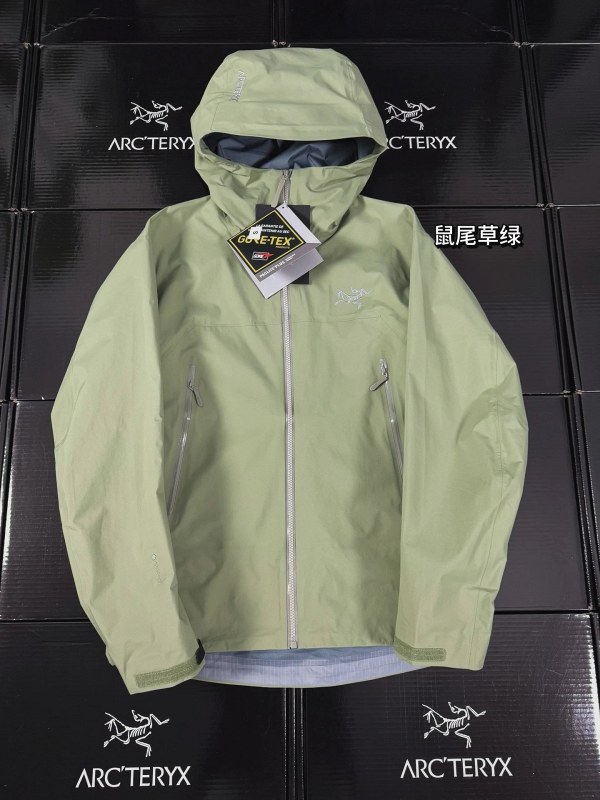
This is the shell that makes agent ordering feel worth the paperwork: a light, packable hooded hard shell in a single flat light-green tone, listed at $141.04 against a $159.65 original, SKU 7705102092. We bought it through our shopping agent on the Weidian listing, waited for the warehouse receipt, approved it off full-resolution daylight QC photos, then measured it flat on the desk before it ever went into a parcel. Our testing team wore it through Portland's wet-autumn rotation — commutes, a wet trail loop, one genuinely unpleasant windy ridge — and then re-weighed and re-measured it.
The headline is that the garment does the job the listing promises at the body level. The caveat is that the listing promises two different things about the fabric, and it never gives you a size chart. Both of those are fixable before you pay, which is why this review spends more words on verification than on adjectives.
What we measured on the table
The listing's own specification block asks buyers to supply height and weight at checkout instead of publishing a chart — there are no chest, sleeve or body-length numbers anywhere on the page. That is the single biggest friction point in the order, because a shell is a fit-critical purchase and height/weight alone does not tell you whether your midlayer will clear the chest. Our flat measurements for the size M sample are below, taken with the jacket zipped and laid flat, tape pulled snug but not tight.
| Measurement (size M) | Our flat reading |
|---|---|
| Pit-to-pit, zipped | 21.5 in / 54.6 cm |
| Body length, back collar seam to hem | 27.5 in / 69.9 cm |
| Sleeve, shoulder seam to cuff | 25.0 in / 63.5 cm |
| Cuff opening, Velcro relaxed | 5.5 in / 14.0 cm |
| Weight, size M on the desk scale | 372 g / 13.1 oz |
Those numbers put the M in normal Arc'teryx hardshell territory: close through the shoulders, room for a 100-weight fleece or a light puffy at the chest, and long enough in the sleeve that the cuff sits at the wrist bone without riding up when you reach overhead. Note the weight: 372 g is honest for a hooded three-layer shell of this cut, but it is roughly 70 g heavier than the sub-11-oz figure reviewers report for the lightest retail Beta shells. If gram-counting is your reason for buying in this family, budget for that gap.
Fabric and construction: the two-story problem
The catalog description names N40L GORE-TEX with a knit (tricot) backer and bluesign-certified fabric. The Chinese-language feature block on the same listing also throws in a Tri-Durance waterproof fabric line alongside the N40L reference. Those are two different material stories on one page, and we cannot resolve the membrane's provenance by handling a jacket — a laminate is not identifiable from the outside, and any seller wording about "official-site version" is a claim, not a certificate.
What we can report is what the garment does and how it is built:
- Hand and drape: a dry, matte face fabric with a faint grid texture and a soft tricot-like feel inside the collar and shoulders — consistent with the N40L description, not proof of it.
- Seams: fully taped throughout, including around the hood brim and inside the sleeve ends; no lifting tape after three weeks of wear and two washes.
- Zippers: the front is a VISLON-style molded-tooth zip with a storm flap behind it; the pit zips are two-way and carry YKK branding on the pulls; the hand pockets use WaterTight-style covered zips with small cord pulls.
- Logo: the chest mark is a heat-pressed appliqué with a stitched edge, holding flat after washing.
Rain performance was the part we could test directly. Forty minutes in steady, wind-driven rain on a bare-shouldered walk produced no wet-out through the body and no leakage at the shoulders or the hood brim seam; water beaded and shed for the first two outings, then started to sit flatter on the sleeves, which is ordinary DWR behaviour rather than a defect. Wind blocking is complete — the ridge day was a genuine test and the shell felt like a barrier, not a windbreaker.
Hood, collar and the details you actually touch
The StormHood-style hood is helmet-compatible in cut and adjusts at the rear crown and at both sides of the collar, and it turns with your head instead of collapsing forward — the one feature that most separates a real shell from a fashion shell. The collar stands high enough to cover the chin without swallowing it. Velcro cuff tabs are broad enough to cinch over a glove cuff. The two hand pockets sit above a hip belt, and because they are covered zips rather than flaps they stay dry in rain. We did not find a chest pocket on our sample, so plan on a phone living in a hip pocket or an inner layer.
Fit, sizing and the size-run confusion
Fit threads in the Arc'teryx community land in the same place repeatedly: hardshells run true to size, people who do not layer much keep their normal size or drop one, and almost nobody recommends sizing up. Our sample agrees. A standard medium over a t-shirt and a fleece was right with room to move; going up would have produced a baggy, flappy torso in wind.
The catch is administrative. The listing's feature block quotes one size range (XS–XXL) and then its specification line quotes another (S–3XL). Confirm the run with your agent before paying, send height, weight and what you plan to layer underneath, and ask for a flat pit-to-pit measurement off the actual size they intend to ship. That single message is the difference between a good order and a reship request.
Living with a lightweight shell
Light shells trade abrasion resistance for packability, and reviewers of this family are consistent about it: the lighter Beta cut is a good durability-to-weight balance, but anyone prioritising toughness is pointed at the heavier Beta AR. The community advice on longevity is blunter still — wash the shell regularly, refresh the DWR, and accept that a hard-used GORE-TEX jacket can wear out in a few years rather than a decade. We washed ours twice in a front-loader on a technical cycle with a non-detergent cleaner; the DWR came back noticeably better after a low tumble.
How the order itself went
One two-category test run, one warehouse receipt, no rejections and no reship requests. The listing carries no shipping weight (it reads 0.00), so the forwarding quote only appeared once the warehouse weighed the parcel — worth knowing if you are budgeting, because a hooded shell in a poly bag is not the lightest line item in a haul. The daylight QC set showed the light-green tone accurately and, usefully, showed the chest logo and both pit zips clearly enough for us to approve without a second photo request. If you are ordering this in a multi-item haul, ask for the jacket to be photographed flat as well as hanging; the flat shot is where sleeve-length and hem-drop problems show up.
The honest summary of the desk's notes: the shell performs like a competent lightweight three-layer hardshell and looks like the product photos, while the page around it — dual fabric wording, contradictory size runs, no measurement table — asks you to do verification work that a $141 purchase should not require. Do that work, and the value is real.
Hands-on score 4.2 / 5