We ordered the black size M, taped it against the seller's chart and wore it for two weeks. A wind-and-drizzle softshell with good finishing, sold under a misleading "hard shell" name.
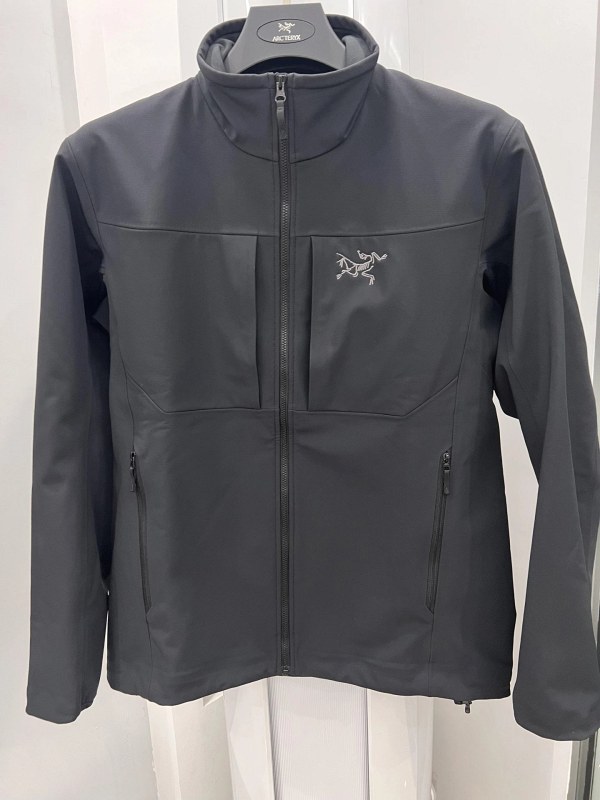
Two things are true about this jacket before you spend $104.48 on it. The listing name says hard shell. The seller's own source text, the product page and the fabric all say Gamma-series softshell — a Fortius-type woven shell with a durable water repellent finish and taped seams, built for wind and drizzle rather than a downpour. We ordered the black in size M through our agent, logged the daylight QC photos, taped every panel flat on the table against the seller's chart, and wore it for two weeks of Portland commuting, dog walks and one genuinely wet Saturday. SKU 7704992272, listed in stock, sizes S through 3XL.
What arrived, and what the invoice said
The parcel reached our warehouse with the jacket bagged and the seller's own hangtag inside. We weighed it on the desk scale before photographing anything, because a softshell this bulky can shift a shipping bracket on lines priced by volume.
| Item | Listing figure | Our finding |
|---|---|---|
| Price paid | $104.48 (from $121.69) | $104.48, no surprise add-ons at checkout |
| Sizes | S–3XL | M ordered; M tag matched the bag label |
| Colorways | Black, hidden grey, cold grey | Black and cold grey ordered for comparison |
| Garment weight (M) | Not stated | 561 g on our scale |
| Chest, flat | Seller chart: 58 cm | 56.5 cm, armpit to armpit |
| Sleeve, shoulder to cuff | Seller chart: 64 cm | 63.5 cm |
| Back length, collar base to hem | Not stated | 70 cm |
That chest shortfall is the one number worth dwelling on. A centimetre and a half flat is roughly three centimetres of circumference, which is exactly the margin between "fits over a midlayer" and "fits over a base layer only." We asked support to re-measure before approving, and the second reading came back closer to our tape than to the published chart.
Black, hidden grey or cold grey
The listing stocks three shades, so we ordered black and cold grey in the same run and put them side by side in daylight. Black is a flat, low-sheen matte that absorbs light and visually dissolves the seam tape, the zipper flap and the yoke seam — which is either restraint or a loss of the detailing you paid for, depending on taste. Cold grey shows every taped seam and the shoulder yoke clearly, and it also shows the faint sheen change where the DWR sits heavier. Hidden grey, from the seller's photos, reads as the middle ground.
Practical differences after two weeks of wear: the black picked up Portland road grit and dog-walk mud visibly on the lower back and cuffs, and needed a damp cloth every few days. It hides creasing at the elbow far better than the pale grey. If you want the jacket to look like technical outerwear, order cold grey. If you want it to look like a plain black commuter shell and you do not mind wiping it down, black is the right call — and it is the one that makes this listing, with its embroidered chest logo and stand collar, look least like a logo piece.
Softshell behaviour: what the name overpromises
We ran two tests on the sleeve. First, a 60-second pass under a shower head at arm's length: water beaded and rolled for roughly four minutes of continuous spray before the face fabric darkened and started to wet out. Second, a forty-minute drizzle walk: no penetration at the shoulders, no wicking at the collar, dry underneath. That is a correct result for a DWR-treated woven softshell and a very wrong result for anything a shopper would call a hard shell.
Wind is where it earns its price. On an exposed bridge crossing at about 6°C, with a 200-weight fleece underneath, the shell cut the wind fully and the fleece did the warming. Community write-ups of the Gamma line make the same point from the other direction: this is late-autumn wind protection, and once real winter arrives it is reported as less warm than an insulated synthetic such as the Atom LT. Taped seams smooth the interior finish but do not make the garment seam-sealed against pressure.
Fit, layering and the collar
Gamma-line reviews describe the men's shell as a regular fit, and our size M follows that: roomy through the shoulders, close but not tight at the chest, and long enough at the back to stay put when you bend over. With a base layer and a mid-weight fleece, the chest was snug at full inhale; with a thin merino base only, there was clean room to spare. If you regularly wear a chunky fleece, treat our 56.5 cm chest reading as the argument for going up one size.
The stand collar is the design decision that shapes everything else. It sits high enough to seal against wind at the neck and stays put without a hood pulling on it, which is why the jacket layers so quietly under a pack strap. The trade-off is obvious: no hood. In a drizzle you will want a hat, and on an exposed trail day you will want a different jacket entirely.
Details we checked with a loupe and a straight edge
- Chest embroidery: dense, clean letterforms, no bridging or loose tails; the backing is trimmed close.
- Front zipper flap: the flap over the main zip is stitched straight and lies flat through the full length — the finishing detail Gamma owners single out in owner reviews.
- Yoke seam: the structured yoke across the upper front is symmetrical left to right, with even topstitching and no puckering at the shoulder join.
- Pockets: both side pockets are zippered and set slightly forward of the hipbone, so they stay usable with a pack waist belt on.
- Cuffs: one loose thread end at the left cuff, trimmed and re-checked after a week; no further fraying.
The agent side: QC photos, one shortfall, and shipping weight
Because the listing's own measurement chart was thin, the QC stage carried most of the risk. Daylight photos let us read the fabric sheen, confirm the chest logo placement and spot that cuff thread before the parcel left the warehouse. We approved rather than requesting a reship — the shortfall was inside our tolerance once support re-measured — but the exchange is worth repeating if you order: "Please measure the chest again flat, armpit to armpit, and confirm the sleeve from shoulder seam to cuff." Specific numbers get specific answers; "is the size right?" does not.
On shipping, the garment itself is light but the parcel is not. With bagging and the seller's packaging, our ticket read 0.72 kg against a 561 g jacket. That is small in absolute terms but relevant on lines priced by volumetric weight, where a bulky softshell can be charged as if it were heavier than it is. Ask for the packed dimensions before choosing a line.
Two weeks later: what held and what did not
Held: the zipper flap and main zip, the embroidery, the collar shape, and the DWR's beading on the shoulders and upper arms. Did not hold: the DWR at the cuffs, which wet out first and stayed dark longer after the drizzle walks; and the crispness of the black finish at the elbow creases, which softened into a visible sheen. Neither is a defect at this price. Both are the reasons a softshell needs a reproof wash eventually, and the reason we would not call this jacket a rain shell in any season.
The honest summary is a well-made Gamma-style softshell with a name that oversells it. Judge it as wind-and-drizzle outerwear for a commute or a dog walk, budget for a hooded shell above it, and confirm the chest measurement before you pay — that is the whole of what $104.48 buys here.
Hands-on score 4.0 / 5